
The crisis that should remake Australia (but probably won’t)
Whatever it is, after the hard times ahead that are coming, we won’t be going back to what was before. Whether we want to or not. How about some big ideas?

Australia is suffering a national crisis not experienced in generations. The 2026 illegal US-Isreal-Gulf war with Iran has triggered a severe fuel and energy shock that has emptied bowsers, crippled trucking routes, and exposed the country’s dangerous dependence on imported petrol, diesel, fertiliser, polymers and petrochemicals — with Australia now importing 80-90% of its refined fuels — farmers desperate for urea from the Gulf, remote communities running on diesel generators, mining operations, and millions of households facing astronomical commuting costs in one of the world’s most car-dependent nations.
Built on sprawling suburbs, over-leveraged freeway homes, vast road-train supply chains across an isolated continent, and an economy that extracts wealth with massive diesel fleets, Australia’s entire way of life was constructed on the assumption of cheap and reliable fuel; that assumption has now collapsed, turning a wealthy resource-rich country’s long-ignored vulnerabilities into an urgent national reckoning — one that brings both deep pain and a rare opportunity for genuine resilience.
The Fragile Foundations Exposed
It’s not just the fuel prices at the bowser, or the diesel allocations that run up day to day for trucking companies, it’s the fertiliser for farmers in an agricultural country. Australia is currently desperately pushing to find more urea (an LNG byproduct), as 64-70% of our supply comes from the Gulf and the Middle East, and winter cropping season needs to be sown. Resilient farmers are looking to change to less fertiliser intensive crops, and the government claims to be searching high and wide for alternative suppliers and products, but the word on the street is that we are in a national fertiliser crisis; something that can act as a prelude to a national food crisis. Oil plays a huge part in feedstock. Diesel is the lifeblood of farm operations, and liquid fuels are the catalysing elements that provide Australians with food from a Darling Downs farm to a plate in Dandenong.
In all the national disbelief, as Australians still book holidays to places with no aviation gas, and the Government has offered no changes to the way we access fuel other than telling us to ‘catch the bus’, many are unaware of the impending catastrophe and both ill-equipped and ill-informed to deal with it. This is especially concerning with strategic stocks sitting at just over a month supply of key fuels — far below the IEA’s 90-day benchmark.
Some on the left may say the fuel shortage is good for EVs, or those on the right may think Trump’s war with Iran is worth the higher cost of living, but they both speak from a position that is both alarmingly ignorant and concerning for the future. Liquid fuel is more than Ford Rangers and cheap plastic crap, it’s polymers for pipes, plastics for vital medical applications, injection molding for vital building materials. Liquid fuel is the base for roads, a key element in pharmaceuticals, synthetic fibers, resins, lubricants, waxes, refrigerants. All totally essential to the functioning of modern economies, across the spectrum of politics around the world.
Australia lacks domestic petrochemical self-sufficiency after eight refinery closures in the past 20+ years (leaving only two operational refineries supplying roughly 17% of national fuel demand); reliance on imported feedstocks compounds fuel import vulnerability. You just have to look at the map to know that Australia’s isolated geographical position leaves it vulnerable to this situation, and Anthony Albanese ringing up everyone in Asia for a couple more tanker-loads isn’t going to address the situation. If the war ended tomorrow, the damage heading this country’s way is already terrifying based on some of the warnings ringing thorough he global economy.
A Perfect Storm of Dependence
The already tenuous idea of buying an over-leveraged developer home on a flat piece of land by a freeway, far away from public transport and shops, and a double digit kilometre distance from work, seems impossible when an already strenuous long drive is met with astronomical fuel and grocery bills. The danger of unemployment caused by possible stagflation only makes the problem worse.
The entire concept of Australian neoliberal housing is based on the motor car, and is untenable without it. Australia has one of the highest vehicle ownership rates in the world, driven by sprawling cities, regional distances, and limited public transport outside major urban centres. Just-in-time supply chains, geographic isolation, and a car-dependent economy are turning out to be a perfect storm.
It takes roughly one thousand kilometres to bring calories from farm to plate in Australia. A mango gets picked in Bowen, Queensland, may have to be trucked down to Ultimo in NSW to a duopoly supermarket distribution centre, before being palletised, wrapped, loaded and trucked back up to a Bowen supermarket shelf. The centralised nature of our highly concentrated corporate giants, leads to labyrinthine supply chains that only make sense to them and their shareholders, and the neoliberal nature of the Australian business’ format means many things are made and stored further up in just-in-time supply chains overseas. Just-in-time-supply chains break when all the things that make them just in time fail.
The division of labour nebulised under neoliberal offshoring is compounded in a vast land poorly serviced by rail, and over-reliant on road-trains that run across the swathe of Australia hostile lands to reach rural towns and population centres that dot this largely uninhabitable country. Generators run remote communities, remote hospitals and police stations, the extracted wealth that is dug by thirsty multinationals mining companies who pay no tax, is done so with the same sovereign volume of fuel used bu ambulances and fire trucks. Who is dolling it out?
Missed Opportunities and Political Failure
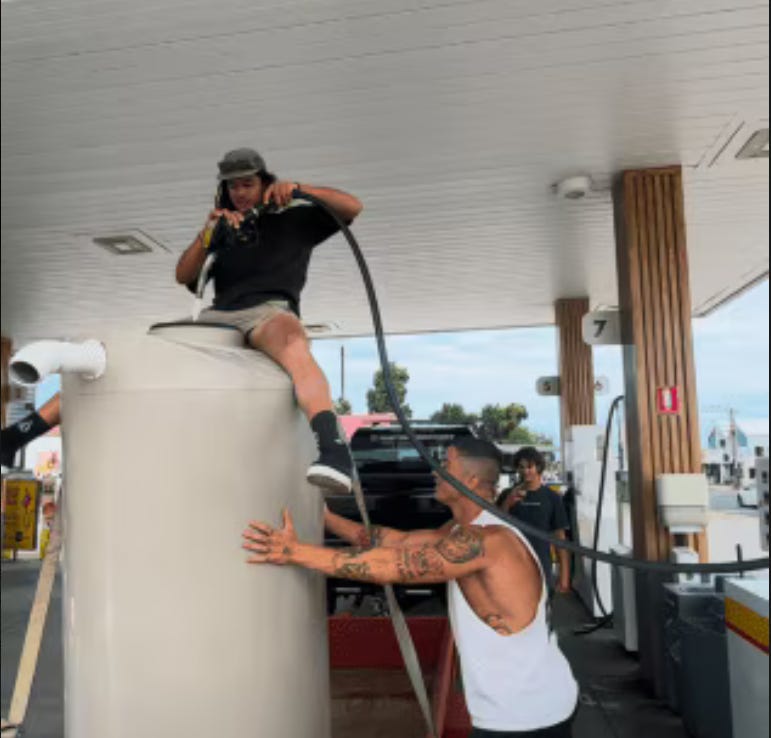
Some may be fearing a Mad Max prequel environment, and are filling old water tanks and plastic containers on trailers hooked to Dodge Rams for good measure. Others may be hoping that the people elected to represent our country may be thinking outside the square a little more.
Penny Wong has ruled out the Russian oil the Filipinos have gained permission from the US to purchase, she won’t address the diplomatic options that US ally Japan took in bilaterally resuming fuel trade with Iran, but Albanese is playing coy going to Singapore and Brunei to scab a few barrels here and there, when he should be threatening to cut AUKUS if the belligerents of this war don’t discontinue blocking the entire global economy so Israeli soldiers can invade Lebanon, conduct a regional war with Iran, and continue committing a UN declared genocide in Gaza.
The coalition is talking about Torana’s, sharing Ampol ad’s from the 80s on social media, and deifying old factory jobs that John Howard destroyed, Labor talks about more neoliberal incrementalism and leans on how good they think they are as blokes compared to the other lot, and they both largely dither during this once in a century economic crisis, and both miss a golden opportunity to make the most of the bad situation.
On the right, the possibility of a Menzies style reset based in full employment, cheap housing and Aussie jobs could sound attractive right about now. On the left, a sovereign minded social and regionally focused national plan that includes housing, jobs and unique national ideas could be massively appealing, and with all those ideas not on the table, decreasing our relations with Israel and the US are polling quite popular…Wait a minute… they are really the same thing! Australians want a sovereign minded government who isn’t secretly working for big business, Israel, or the United States national interest. Its not currently available.
This is the ultimate low hanging fruit. Guaranteed to ensure political clout and a public mandate that could last for a generation. Australia could be recreated in the vacuum like it was after the US left the region in WWII, it could dream a new world if the right people were in power to see it. Electrification, green steel, high speed rail, renewable projects, nation building projects that realign our multicultural country under common goals and values that are modern and cutting edge. Green Armies, diplomatic corps, prison rehabilitation programs, a national building commission that puts half the nation to work building the affordable homes they will one day live in with Australian made materiel.
Whatever it is, after the hard times ahead that are coming, we wont be going back to what was before. Whether we want to or not. How about some big ideas?
But so far, this government has offered little more than cautious navel-gazing and the familiar refrain to “catch the bus”. It cant even review taxing the multinational gas giants, allowing another ripe piece of fruit to fall from the vine — ready to be devoured by political carrion birds such as Pauline Hanson and Clive Palmer. While Australians from both sides of the aisle desperately crave a genuinely sovereign solution, none is in sight.
As the crisis deepens, the government’s reactive efforts appear hollow. They come against the backdrop of a thirty-plus-year legacy of involvement in Israel-US conflicts across the Muslim world — a legacy that has helped shape the very fuel shock now gripping the nation. As Australians make tough choices in the months ahead, many will also grow tougher on the decisions that led us here, and on those in Canberra on all sides who failed to prepare for this day.
Well said Joel, but pse be careful with statements like "It cant even review taxing the multinational gas giants, allowing another ripe piece of fruit to fall from the vine..."
Such statement suggests that if the Australia govt. collected more tax from transnationals (or "the wealthy") national govt. would have more money to spend on social support for citizenry - a reafirmation of the neoliberalist mantra that tax revenues fund Fed, govt. spending - they DO NOT.
How many times have we heard the familiar refrain from neolib Fed Treasurers "we would like to have funded "x" program but couldn't because we couldn't find money for it in the budget."
That is a straight ot lie - all budget spending is a political decision - the Fed govt. never has a shortage of money, it issues the stuff by passing a money supply bill.
There could well be a shortage of necessary resources to implement such social reform, but in most cases that can be overcome by spending in ways that increase availability of needed resources to offset any inflationary effect.
The 'Federal Budget' is not a real 'budget' in the financial sense of that word - it is an outline of governance intentions. The limit of practical implementation is not the govts. available 'supply of money' - it is the ability to activate/harness available resources to achieve those set out objectives without inducing inflationary pressures.
Menzies spent on building full employment because he had no choice - he had 600,000 returned soldiers; a total of ~1 million people (~14% pop.) discharged from military service. Post WW2 civil rehabiltation was the priority - corporatism hadn't yet got it's act together to infiltrate/control govt. policy.
Menzies should be viewed in the context of those times; the Curtin/Chifley 1945 'White Paper' realisations :
"...during the war no financial or other obstacles have been allowed to prevent the need for extra production being satisfied to the limit of our resources. It is true that war-time full employment has been accompanied by efforts and sacrifices and a curtailment of individual liberties which only the supreme emergency of war could justify; but it has shown up the wastes of unemployment in pre-war years, and it has taught us valuable lessons which we can apply to the problems of peace-time, when full employment must be achieved in ways consistent with a free society.
In peace-time the responsibility of Commonwealth and State Governments is to provide the general framework of a full employment economy, within which the operations of individuals and businesses can be carried on..."
From 1942 to 1970 Aus. unemployment rate was <2% proving that full employment is possible without wars.
As per above, the unemployment rate is a political decision - whilever available resources exist to be activated/mobilised/industrialised.
We need another Gough Whitlam - a leader with vision and courage to face down the neolibs. But, alas, the lesson our politicians have taken from Whitlam's dismissal is don't get the US corporatist authoritarians/fascistic media moguls offside if you want to be re-elected.
Hence Australia's unremitting rise of US/UK aligned neoliberalism - gutless politicians refuse to confront the hegemon/s despite the obvious escalating social/ecological devastation.
Thank you for this important post , and especially for your conversation with Rex Patrick . He is much missed from the Senate .
Just on another aspect of “sovereignty “, I read in a recent edition of The Saturday Paper of how the CSIRO is being defunded , and staff being reduced . Apparently , if profits cannot be clearly demonstrated , the work is of no value .
What is it about Scientific Research that this government appears not to understand ? Would they have sacked Jonas Salk
if he failed to show an immediate profit in his vital work against polio ? ? Why can this government not understand the value of research ? They thus contribute to the lowering of expertise within this country. To their perpetual shame .
( And don’t start me on their refusal to cancel AUKUS !! 😡)