
A lesson in what not to do
Australian support for the conflict causing the global fuel crisis clashes with the realities we face at home.

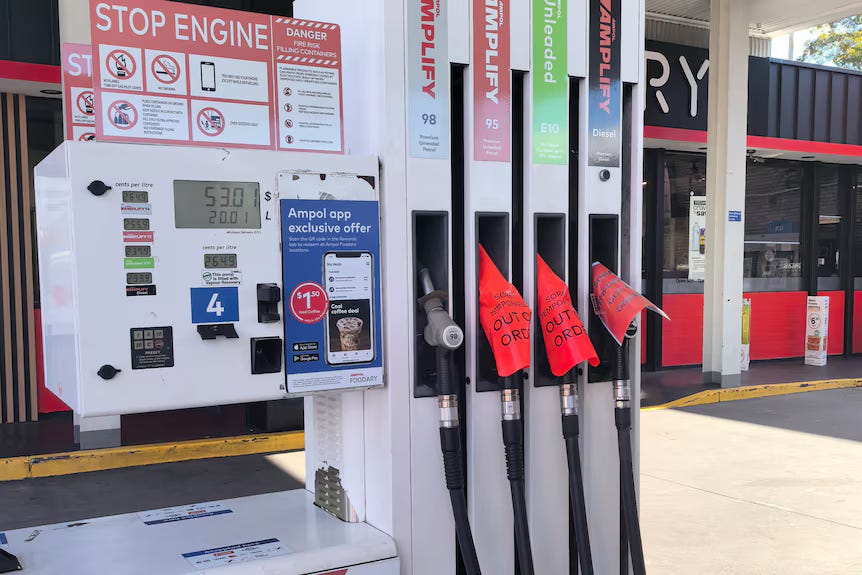
The strength of Australian fuel security has been brought into question during the war in Iran and the boiling crisis in West Asia, and Australia’s decision to be involved doesn’t help the situation. As nations scramble to secure their energy needs in an uncertain future, Australia could be poorly positioned due to a number of factors, not least a bipartisan policy that has outsourced vital sovereign considerations including national fuel security, and a foreign policy that has put Australia front and center on the list of belligerents in this conflict.
The Prime Minister Anthony Albanese, his Energy Minister Chris Bowen and the government have spent the last couple of weeks in crisis mode responding to the fallout from a regional war his government has militarily supported from the onset. And just as the government has not reckoned with the fact that Australian service people have been involved in taking Iranian lives at the onset of this illegal conflict, it has not quite reckoned with the fallout from the actions of it.
Australia is tethered to the pointy edge of this war. Albanese was bending over backwards to approve the Netanyahu-Trump invasion of Iran. Now he is deploying a Fuel Task Force to oversee the allocation of available fuel as a consequence of the war he supports. A lesson in what not to do. In the vital Asian trade node that doles out the refined fuels needed to run Australia, it might be considered how Australia’s recent diplomatic footprint will determine its fate in a dwindling pool of resources.
In three weeks the world’s energy supply has all ground to a halt, along with the supply chains that deliver it, with consequences mounting by the day. Fuel shortages and service station closures around Australia make international news, services take on levies, shops run out of stock, and supply chains strain under pressure. Australia is a just-in-time economy, with time about to run out.“Our Fuel Supply Taskforce is up and running”, announced a rather confident looking PM cast against what the IMF is calling the worst economic crisis in eighty years (WW2). The government hailed some success in arranging a bilateral fuel arrangement with Singapore, and is reconvening the Fuel Supply Taskforce to look at additional measures, but that casts against an environment of rapidly developing supply chain issues and force majeure actions being made on significant oil and gas contracts around the world.
The Netanyahu-Trump war on Iran is a disaster. The spiking price of oil has sat next to the crashing western financial markets, the global economy is taking on shocks that cannot yet be fathomed, and the world rapidly shifts towards a period of uncertainty. Global markets have transformed into daily yo-yos dependent on President Trump’s performance of a diplomatic pantomime involving the simultaneous announcement of war and peace from the White House, met with total rejection from Tehran, and compounded by the escalatory ladder that sees further destruction of vital energy infrastructure and the crippling of the global markets.
Our greatest friend and security guarantee under Trump in Washington has gone beyond the pale in its invasion of Iran, and so too has Canberra for supporting it. Only stirring the pot is the Israel-US ‘good cop-bad cop’ approach to the conflict, compounded by Iran’s unwillingness to engage diplomatically, and as it stands, apart from the disjointed announcements from the Trump camp, there are no signs that this conflict is going to end any time soon. The options available in Australia are limited, partly due to the government’s willingness to support the Israel-US war from the outset—and for a country run by governments so keen to be involved in US misadventures in faraway lands, you would think it would have the wherewithal to secure an energy buffer for when that foreign policy pastime goes awry.
A complex asymmetrical war develops along an escalation ladder, with every rung another step too far away from a diplomatic exit, and a catastrophe for global energy supply and the economies and lives of billions. Iran is not accepting America’s terms, and America is not agreeing on the counter-proposal from Iran, and in a battle where both sides seem to be measuring completely different metrics of success, the damages to vital global energy infrastructure seen in barely three weeks seems minor to the cadence of what this war could wreak if it goes beyond three months.
Downstream from the frozen fuel nodes in the Strait of Hormuz, Asian fuel refiners scramble to take in the reality, and act accordingly. Our Japanese oil refiners amend their outputs and their clients, Korean and Singaporean suppliers respond to government calls to secure domestic supplies, and China halts almost half of its consignments of aviation fuel to Australia. Between the Asian refineries and the hungry ports in Australia live hundreds of millions of people in dozens of countries, many of whom have better relationships with each other than we do with them. Europeans are looking at multilateral contingencies, Asians are revisiting multilateral diplomacy to re-imagine Asia’s energy mix, and Australia looks pretty isolated sitting with a bunch of Pacific Islands we have been pissing off for decades down here at the bottom of the earth.
The situation would not have been so dire if bipartisan governments didn’t move to close 8 refineries in two decades, leaving one of the biggest nations in the world by landmass with two oil refineries. Long-term structural failures in energy policy have seen decades of under-investment in refining and fuel security. Australia has a couple of handfuls worth of fuel reserves, and a heavy reliance on imported refined products leaves Australia one of the most vulnerable modern economies in the world.
“Without Trucks Australia Stops” is a common sign spotted on the back of endless fleets of diesel trucks that run overland freight across vast distances where our energy returned over energy invested strains across the harsh space that separates a unique geography. Road trains running up the Hume and across the Nullarbor hail others turning down crossroads that lead to remote locations that are bone dry of fuel, and far away from a solution. Gardening maintenance companies to postal fleets see the price of logistics double at the fuel pump, MRI operators to fish and chip shops run low on helium and packaging.
The closure of the biggest gas fields in the world (Qatar, South Pars (Iran)) means vital gases for energy, high tech production, and medicine are unaccounted for. The collapse of the Gulf petrochemical industry means a halt in plastics, polyester, polyurethane and paracetamol. As the IMF issues dire warnings along with establishment financial experts, there is a developing crisis in the supply of Urea and Ammonium Nitrate fertilisers. Farmers can’t power their machines, and world hunger joins the equation. The flow-on effects of the crisis are endless.
In a situation like this, sovereignty is the driver of a nation’s response, and as nations from the Philippines to Burkina Faso seek to enact national emergency measures, the Albanese government has taken some more time to consider. Japan and Korea, both with 200-day sovereign fuel reserves, have enacted restrictions. Both of those countries refine the fuel that makes its way to Australia at the end of a fragile resource supply chain that is being rearranged.
Footage of middle Australians filling up jerrycans, old water tanks, and industrial storage units on the back of thirsty Dodge Rams paints a bleak reality. The Albanese government has yet to deploy any measure to combat this practice. Citing the rage, Coalition White Knight Andrew Hastie has made the most sovereign sounding statement made by a Liberal politician in recent memory, condemning Trump’s war, saying Australians are “suffering” because of it, and placing the blame for the crisis on the White House. This marks a shift that is growing rapidly against anyone in Canberra upholding this status quo, and applying additional pressure on any political entity prepared to uphold it.
Matt Canavan is posting old Ampol ads on his social media, Pauline Hanson and Clive Palmer are threatening to tax the foreign-owned gas giants, the Greens are embarrassing the government in the Senate, Hastie is stirring sovereign pangs in the heart of middle Australia; the Albanese government stands alone, refusing to budge, as the world crumbles around them, as the number one party of Trump in Australia, and the number one party of war. Not a good look in the current political situation.
Albo’s decision to lump in has been made as fast as one could, and his support for the US-Israel war is more than words; it is the deployment of Australian military personnel to an opaque war that has repercussions that go beyond the cost of petrol and the price of groceries. This isn’t some automatic decision. It’s not to be taken for granted. This is the most consequential conflict Australia has had to consider in generations, filled with the pitfalls, traps and tinged with messianic open-endedness. What the fuck are the government doing getting so close so quickly into this war?
The crisis in the Gulf has stirred up the global economy in ways not yet fully reckoned with—a situation compounded in Australia which sits in this predicament partly due to proximity and policy. What a disgrace that our government stands before us with serious faces, acting like prudent sovereign managers, when they have committed diplomatic and military support to the belligerents of the conflict and those responsible for the catastrophic situation in the Gulf. The fuel crisis in Australia is due to a bipartisan neoliberal economic policy that has prioritised corporate profits over national security. It’s partly due to geography, but it’s also due to the sovereign, moral and ethical decay of the Australian political class.
AFAIK, in the Australian Parliament, only The Greens opposed the US war of aggression on Iran. Only The Greens and some micro parties opposed supplying the Israel g3n0c1d3 of Palestine. Only The Greens have consistently and genuinely supported a transition away from petroleum transport and heating systems. Do you see the pattern? For genuine solutions: https://greens.org.au/platform
Thank you for expressing so eloquently and comprehensively the sabotage of Australia by this ALP govt, in addition to its bloody hand in genocide, ethnic cleansing, societal division.