
Who owns a national tragedy?
The Australian people are being denied access to a tragedy as competing forces vie for control.

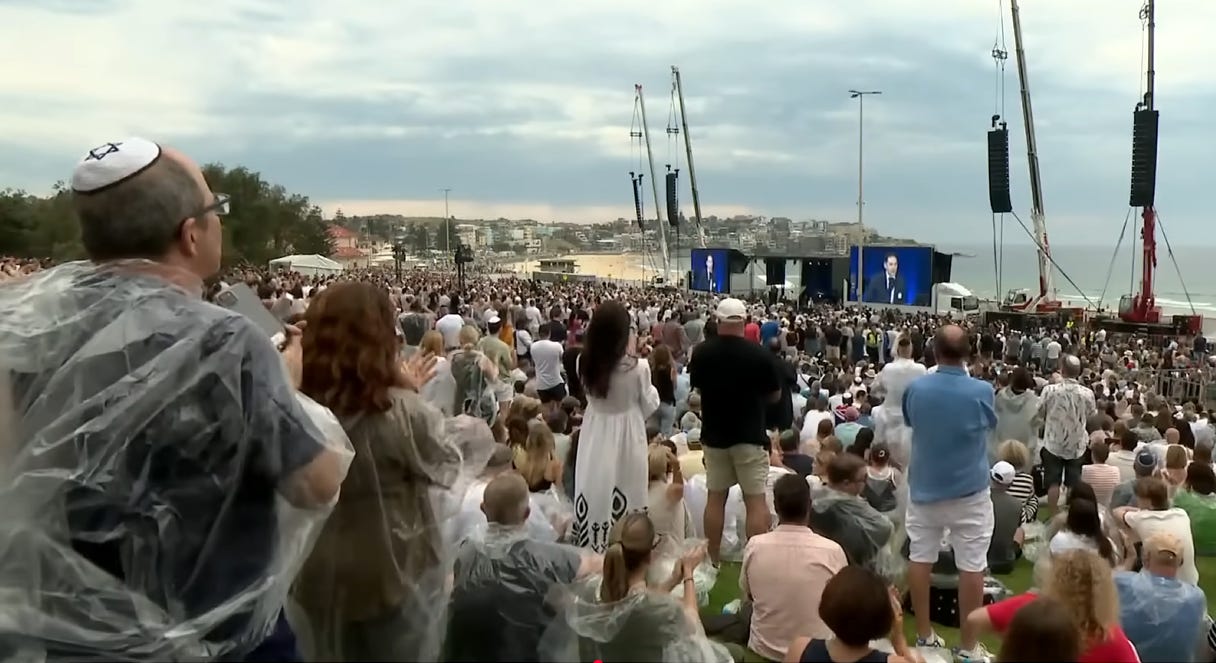
In the aftermath of the Bondi shootings, a split in the narrative has emerged. The government is competing with the media, political opponents, and foreign elements like Israeli officials, all while grappling with the Australian people’s response to this national tragedy. These competing forces are disrupting the natural path toward reconciliation and healing, compartmentalising the grieving process and limiting organic access for the wider community.
A week on from a national tragedy where two armed shooters fired upon a Jewish holiday gathering on the Bondi foreshore, the Prime Minister Anthony Albanese was met with boos as he attended a memorial to remember the victims. Others were met with cheers—like Pauline Hanson and Barnaby Joyce—who were treated very differently from the jeers directed at Tony Burke or the warm praise for Josh Frydenberg. Notably, NSW Premier Chris Minns, of the same party as Albanese and who has signalled the banning of protests, the outlawing of chants and tougher gun laws, was met with standing ovations.
The cheers and boos at such a location seemed charged and sat out of kilter with the reality of the horrors that occurred there only days ago—out of place during a period of solemn national mourning—adding a loaded emotional element that clouded the essence of the occasion. The growing politicisation of the vigil had taken place sometime earlier in the week, and the site went from a respectful memorial to a political launchpad.
All week, Ray Hadley, Sharri Markson, along with an ethically bereft cohort of legacy media talking heads, descended on the Bondi site, while Josh Frydenberg hinted his political comeback next to bouquets of flowers and messages to the victims. Meanwhile, the Prime Minister and his government—who had spent the week informing the public of impending restrictions on freedoms in response to the event—struggled to connect with the same audience.
Mourning Australians, including those in the Jewish community personally affected by this disaster, have not received the simple compassion typically expected in such events. Instead, they have been besieged by political opportunists. Already gone are the simple flowers and solemn reflection, replaced by amplified voices on PA systems making demands of the government—and, by extension, of the entire Australian population—to further alter the political fabric of society and the freedoms its people enjoy.
Overseas, the overarching demands of Israel are another unique factor complicating the tense situation. Israeli Prime Minister Benjamin Netanyahu and his cabinet issue decrees, warnings and directives towards the Albanese government, naming him personally responsible for letting “the disease (antisemitism) spread”, blaming his government’s recognition of a Palestinian state. Albanese, who has not criticised the security failures of the Israeli PM on October 7, nor blamed him for the rise in anti-Palestinianism since the UN declared genocide in Gaza began, has not been treated the same as he tries to deal with his own national tragedy.
While foreign interests are trying to retrofit the political objectives of a foreign power onto our domestic way of life, the aftermath of Bondi has been swept up by vast international networks of political agitators in foreign media who have no concern for the social cohesion of Australia, nor for the Australian victims of Bondi. Ex-presidential candidates in the United States like Nikki Haley and war-enthusiast Senator Lindsey Graham have now joined a hive of big international online personalities, and Zionist sovereign movements like Betar Worldwide, to unleash a well-financed multinational propaganda machine onto Australian society.
This should be a moment when the population comes together to make sense of where the country is and how it got here, just like any other national disaster that befalls us. This moment is different. Blue and white are now the dominant colours at the vigil, and the speeches have shifted from conciliatory to polemic. The tone is moving from an accessible public memorial to a campaign environment, and those who seek to control the narrative of this tragedy—and turn it from an Australian act of solidarity into an exclusive and ultimately political objective—risk isolating the tragedy under one very specific social demand.
It wasn’t so long ago that the Christchurch mosque massacre shocked the world in 2019. Australian far-right mass-shooter Brenton Tarrant inflicted the worst mass shooting in New Zealand history after gunning down Muslim worshippers in a heinous act of religious and political violence. The Bondi shooters, Sajid Akram and his son Naveed Akram, also carried out a heinous act of religious and political violence--there are immediate similarities surrounding the details of the two massacres--yet the national responses could not look more different.
In Christchurch’s aftermath, New Zealand wrapped its arms around the shattered Muslim community in a display of national character that still defines the country’s social health today. New Zealand Prime Minister Jacinda Ardern wasn’t booed; the media didn’t undermine collective safety; political opportunists didn’t infiltrate the grieving crowds to make announcements. There were no boos at all—because none were deemed appropriate after a shooting that defied the nation’s character, just as the Bondi shootings defy Australia’s. So why should Australia’s response differ?
What defined Christchurch was its framing as an attack on all New Zealanders, not just Muslims. The hakas, ceremonial embraces, and multicultural access to grieving underscored that. Victims were embraced as New Zealanders by New Zealanders, with no efforts from the Muslim community to isolate itself—only shared tears as a nation. Former PM John Howard—a man now joining the opportunistic pile-on against Albanese—once called for unity after Port Arthur and received it from the press, opposition, and most Australians. Can the same be said for Albanese after Bondi?
Albanese’s response to the Bondi massacre echoes the muscle memory of John Howard’s after Port Arthur, but in a vastly different political environment. And more recently, after Christchurch, New Zealanders stood shoulder to shoulder with the Muslim community—yet some elements at Bondi appear to assemble for more exclusive reasons, blocking broader access to the national grieving process, and denying the government passage to lead during this crisis. The two disturbed extremist nutters at Bondi do not represent anything remotely Australian, whether it be values, history, culture, antisemitism or migrants. Every society has people like the Bondi shooters, even the most peaceful like NZ and Norway, and this government should be focusing on preserving civil liberties and freedoms, knowing that crazies will occasionally slip through the net in such a challenging global environment.
The government must be in shock. It can’t secure a media interview without blame being attributed to it for the tragedy. It lacks bipartisan solidarity. It receives no condolences from foreign “allies,” some of whom have openly called for it to step down. It can’t even garner a warm reception from those at the Bondi memorial. One can only hope it’s listening to the majority of Australians, who believe investigating intelligence and law-enforcement failures may prove more effective than further eroding public freedoms.


Australia is a peace-loving country, full of people who abhor violence, yet it has a social consciousness often exploited by both sides of politics. That consciousness has seen Australians support one another during bushfires, floods, and emergencies, while empathising with victims at home and abroad—whether those of Bondi or Gaza. Australians care deeply about their own in crisis and grieve the innocent lives lost at Bondi on December 14—but they do not share the same affection for Israel or its ICC-wanted Prime Minister Benjamin Netanyahu.
Why, then, are Australians—many critical of Israel’s war in Gaza, opposed to political violence in all forms, and marching peacefully for peace while sharing grief for Bondi victims—expected to bear the brunt of blowback from two years of overseas conflict now reaching our shores? The Albanese government, still clinging to its small-target strategy from opposition days, has hobbled itself through acquiescence to competing interests, compounded by maintaining its economic, military, and diplomatic normalcy with Israel during this dark chapter in history, torn between the jeers at Bondi and the disappointment in its base.
As many Australians grapple with this horrific massacre that killed 15 and wounded dozens, it already feels as if access to the tragedy is slipping from public grasp, revolving instead around a small group of powerful interests reshaping it into a set of exclusive political demands. Barely a week after Bondi, NSW Premier Minns stands before his people and declaring they would face new hate-speech laws, noting that “we don’t have the same free speech laws they have in the United States and we don’t make any apologies for that.” Another compartment of public freedoms stripped from a population shaking their heads, wondering how outlawing pro-Palestinian slogans is going to prevent isolated terror cells with links to ISIS from evading federal intelligence and committing crimes while on anti-terror watch-lists.
Ultimately, true healing demands more than political point-scoring or hasty curbs on freedoms. Australia must prioritise thorough investigations into intelligence lapses, foster genuine bipartisan dialogue, and reaffirm our shared values of inclusivity and compassion—embracing the Jewish community not as a separate group, but as fellow Australians. By reclaiming this moment for collective mourning, reflection, and unity, we can honour the victims, support the survivors, and ensure that hate does not dim the enduring light of our shared Australian identity.
Joel, well said, you’ve covered the position of the majority of us very well. I’m so sorry that this tragedy has been hijacked by selfish opportunists and overseas interests.
Let’s be very clear: this massacre has every characteristic of historically precedented Mossad operations. In this sense, there was no ‘intelligence failure.’
Local ‘intelligence’ outfits are TOTALLY beholden to the cia/mossad complex.
At this very moment, Mossad operatives, having demanded complete access to all relevant evidence are covering their tracks and creating fictional narratives to explain how two suicidal ISIS trained mentally ill nutters , having been under observation, were allowed to be heavily armed, allowed to travel to Isis training camp (Isis being a cia/mossad-controlled and funded mercenary terror group) in US friendly Phillipines , then , in a moment chosen to be perfect for propaganda perfects, let loose on a civilian gathering.
Netanyahu’s script was carried out almost perfectly. He will be cursing Ahmed Ahmad to the grave. This is Israel’s Christmas gift to Australian institutional fascism. Cui bono?— every dog breathed hack and opportunist politician is frothing at the mouth . Not with sorrow, with exuberant joy. All these tepid ‘liberal democrats’ were just dying to get their fascist gameday suits off the rack. Watch them gloat. This might be the most disgusting and retrograde moment in Australian colonial history.