
The security umbrella is leaking
Iran has stress-tested American power. The results should end every remaining AUKUS illusion.

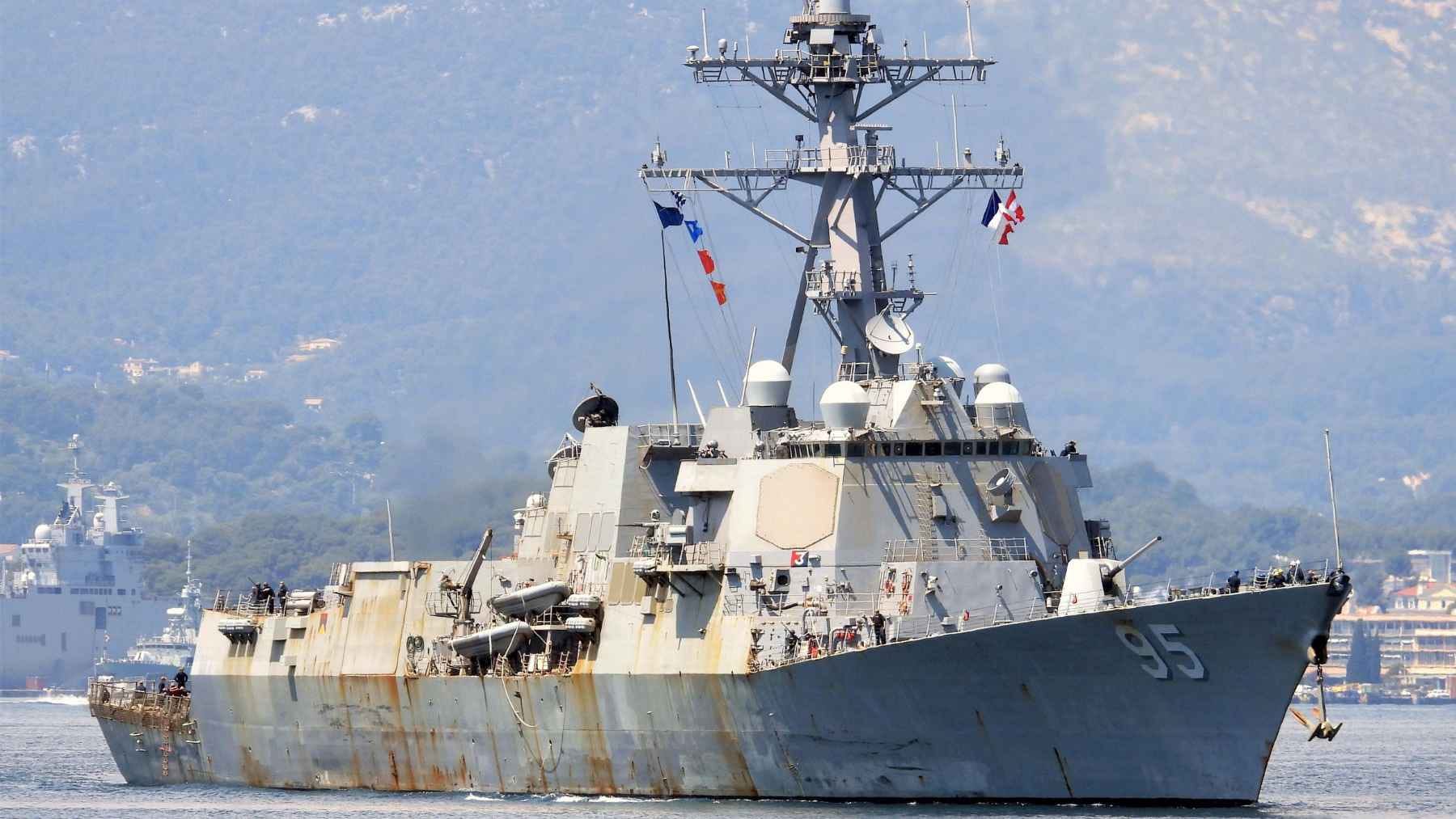
The war in Iran has put US military power on display in ways not seen in decades, exposing glaring gaps in capability. As AUKUS faces the consequences of these realities abroad and increasing scrutiny back home, the government in Canberra presses on stubbornly and irresponsibly at ‘full steam ahead’.
It is now objectively simple to critique US ability to maintain basic fleet readiness and sustain prolonged combat operations. An Arleigh Burke warship is filmed in the large Warlike Operations Area (WAO), somewhere between the Strait of Hormuz, the Gulf of Oman, and Diego Garcia, looking rundown and rusted. In the middle of the South China Sea, another vessel of the same class loses power, water, air conditioning and toilets for four days—floating aimlessly in what Washington considers hostile waters. These examples, not isolated but rather widespread, are emblematic of a military power in decline.
A mother spoke of her 21-year-old son serving as a naval electrician, malnourished and losing 10 kg on his extended voyage at sea, under a President who openly mocks US service people while jamming them into a war against Iran on behalf of Israel. Sailors have been reported attempting to jump off the deck of the USS Abraham Lincoln; reports of mental health problems are rampant. Photos emerge of meagre and unhealthy servings of food, blocked toilets, and dire conditions aboard vessels that have been in the open seas for hundreds of days without seeing land. US-based academic Trita Parsi published a photo he received expressing the sentiment of US service personnel floating in the waters off the Persian Gulf, scribbling words onto the air flap of a plane: “Be a good guy and do what Israel tells you to”, “Operation Epstein Fury”, “Peace deal #64 incoming… ALL THIS FOR THE HOLY LAND”, and “Bibi’s cucks”. The morale of the force is clearly broken.


Secretary of War Pete Hegseth looked aloof and almost concerned when he addressed the cameras, facing some heat at what appears to be a deepening crisis in naval readiness, crew welfare and public confidence. His response was to dismiss the reports as “completely misrepresented,” while insisting every crew is provided with everything possible.


Artillery has played the part of a battlefield for centuries, and 155 mm artillery shells are not as complex as other weapons to mass produce, but they are proving to be a challenge for a declining military power at full flex in multiple continents. A technology over a century old is getting hard to come by, especially after spending much of its ordnance stockpiles on the proxy war in Ukraine. After the Israeli genocide and war in the Middle East, the US is only managing barely 10% of outputs in 155 mm artillery it managed to achieve in the 1980s, and efforts to ramp up production have resulted in burning robots and defect shells, with a technician calling the endeavour a “waste of government money” and a “waste of our time”.
If the US cannot produce artillery shells that have been around since the 19th century, how can it produce the precision-guided munitions, the drones, and the complex nuclear submarines needed to service its own ambitions, let alone fill the order dockets that sit under nearly half a trillion dollars of AUKUS? If the Americans can even spare them, what problems will multi-decade-old SSNs deliver on their arrival? Will Australian tyre-kickers at the docks even know what problems they need to look out for? Where the rust patches are?


Far beyond the submarine-shaped paperclips and the fancy nibbles in Washington, blocked toilets and rusted bulkheads now exemplify AUKUS through the lens that sees the current US Navy in the Persian Gulf, and warped shells and strained supply chains illustrate the underlying issues that dog the program from the get-go. How are our overzealous leaders in Canberra watching all of this without considering a plan B?
The 4D chess crowd aside, Trump himself is a factor in the rapid evaporation of US military prestige. It is his administration that dispatched the military to the region and revealed it in such poor shape, and his stanza of escalation that has transfigured the stubborn Western orthodoxies of great-power competition dominant since the “End of History.” There currently isn’t a Chinese carrier in Asia — an uncommon situation — and the limitations of legacy naval tonnage against cutting-edge hypersonic missiles and drones should be a wake-up call. Ambitious aims to contain China through a large naval force in situ are now a fever dream. Without the ability to mitigate Iran’s asymmetrical missile power, how can the US continue to dream of meeting the much more imposing People’s Liberation Army Rocket Force (PLARF) in its own territory over another act of military aggression?


In a great-power contest with China, keeping powder dry was essential. The idea of modern missile war using drones and cyber was never means-tested, and US mystique remained unquestioned until it met a satellite-capable, tactically prepared and strategically bold Iran. Bases in the region are all but crippled and evacuated, Iran controls the Strait of Hormuz and substantial percentages of the world’s energy and fertiliser traffic, and the US military may have suffered its Suez Crisis. A poor display, potentially a defeat, updates the firmware of every opponent measuring American power and brings into question the fabric and integrity of the security umbrella sought by its allies.
The Albanese government has already given up stockpiles of Australian 155 mm ammunition to the war effort in Ukraine, it has ceded sovereign agency to host US bases that will only be targets in future regional wars Washington plans to start, and it is posturing to usher the population towards consenting to a US narrative that insists on conflict with China—it has butchered enduring and nuanced diplomatic relationships with our neighbours in the region, enabled Israel in its genocide in Gaza, and it has bullied any nation it can on a mission of half-arsed deputy work in the Pacific.
The current public enquiry into AUKUS is demonstrating an array of consensus on its submissions, from notable figures from many fields of expertise, that point not only to the poor choice with regards to value and acquisition, but to the dangerous sovereign submission to a foreign power that all but voids our future decisions. Within the country there are enough people that know what they are talking about, ringing alarms on AUKUS, and those same people have viable ideas for a plan B that seems deliberately missing in the halls of power.
Former Foreign Minister Bob Carr says we can exit AUKUS “without a rupture” and develop long-range strike with other weapons systems. Retired Rear Admiral Peter Briggs has promoted alternatives like the French Suffren-class (Barracuda family), amongst other long-standing ideas like acquiring off-the-shelf Japanese submarines. Most of the key submissions, including former Prime Minister Malcolm Turnbull, criticised the lack of any Plan B, highlighted the high risk of ending up with no new submarines, and called vociferously for a full exit from AUKUS Pillar 1. The knowledge and the alternatives already exist inside the country. The only thing missing is the political will in Canberra to use them.
Fear is the real engine of AUKUS

An independent public inquiry into AUKUS heard submissions from former Foreign Minister Gareth Evans, Tilman Ruff (ICAN), Richard Tanter, former Senator Rex Patrick, and former Prime Minister Malcolm Turnbull. The AUKUS Public Inquiry has received over 500 written submissions from across many sections of Australian s…