
Machines of loving grace?
Our government is busy granting AI-themed contracts to Epstein-linked tech giants, while guard rails to protect Australian citizens in an AI-driven Wild West seem few and far between.


Australians are losing their right to digital safety and freedom. Revelations show that biometric and identity-document data are to be transferred to the Trump administration’s Immigration and Customs Enforcement (ICE) database. Without setting foot in the United States, Australians could be catalogued by the US Department of Homeland Security (DHS) under an arrangement that could grant agencies such as ICE full access to Australian biometric and ID databases.
An article by Bernard Keane for Crikey brought the story to light, revealing that the Albanese government is in discussions with the Trump administration to establish an “Enhanced Border Security Partnership” (EBSP) with the DHS. This partnership will potentially include the transfer of Australian biometric data to a sovereign DHS system that could extend to voice and iris recognition data. Unlike passwords or tokens, you cannot “reset” fingerprints, iris patterns or voice prints. Every packet of data sent creates a permanent, cross-border tracking risk. Something Minister for Home Affairs Tony Burke has avoided commenting on.
Another Crikey contributor, Cam Wilson, has written about a recent defence pact that sees Palantir secure a $7.6 million contract for the Cyber Warfare Division ($26 million overall) without a tender process. Independent Senator David Pocock questioned the scale of the contract and the integrity of the recipient, calling it “deeply problematic” for a company with a recent history of nefarious data handling to be awarded such a substantial contract. This is also a company receiving the contract as its stocks tumble in the wake of key figures being named in the Epstein files.


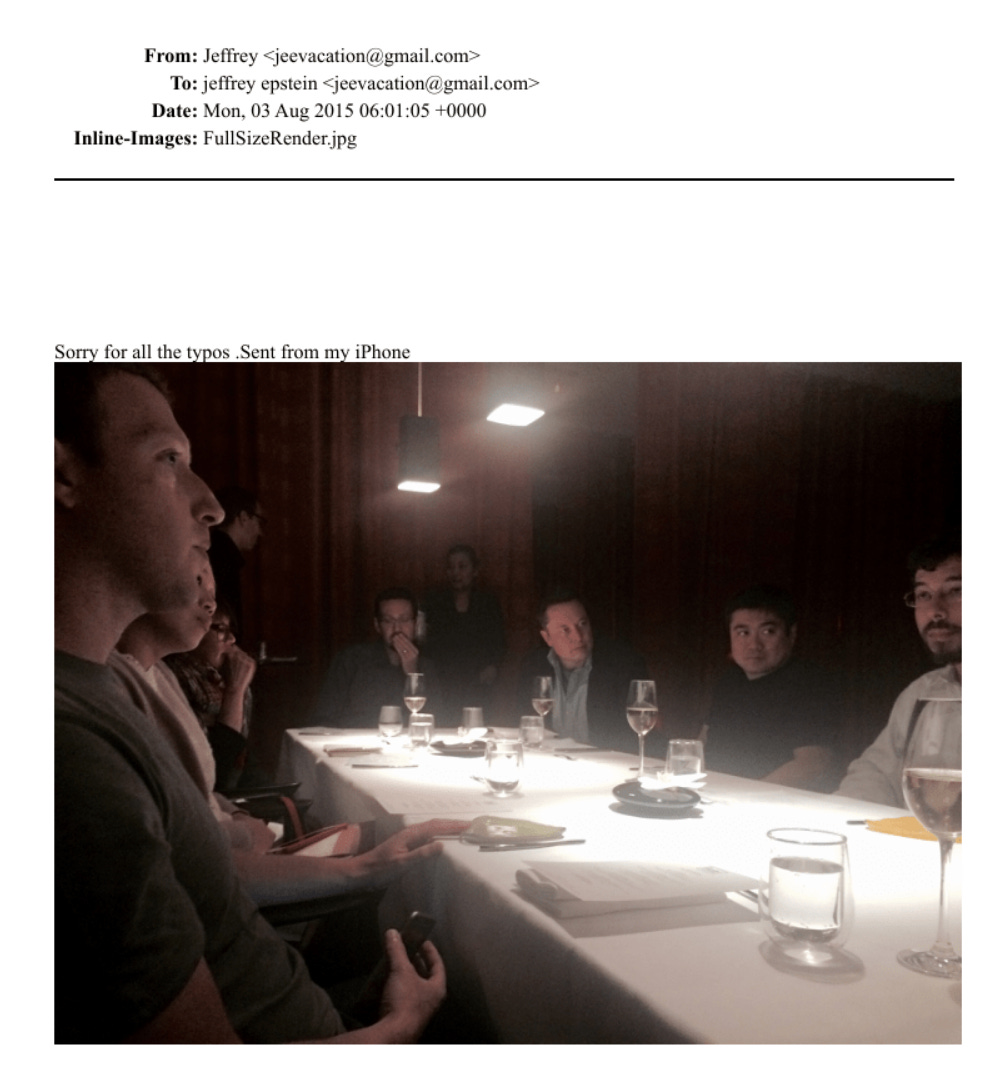
All of these arrangements are occurring in the post-Epstein political environment, where key figures in the tech industry — including those linked to Palantir and other giant companies that build and maintain sovereign government and defence tech infrastructure in Australia — are implicated in disturbing elements of his dealings. Bill Gates' and his company Microsoft, a man beleaguered by his own pocket of the Epstein scandal, has secured a multi-billion-dollar cloud computing contract with the Albanese government. Elon Musk’s Starlink has secured a contract with the ADF, and tech giants all linked to the Epstein files — such as Google/Alphabet (linked to Sergey Brin and Eric Schmidt), Meta (Mark Zuckerberg) and Reid Hoffman (LinkedIn/Microsoft ties) — continue to expand their footholds.
Before the surreal, almost comedic clips of CEO Alex Karp swinging swords with over-conviction in offices and threatening to spray detractors with fentanyl-laced urine from drones became public memes — but after Palantir started testing its systems with the IDF in Gaza — supermarket duopoly giant Coles cut a deal with Palantir in February 2024. The company was tasked with deploying an Artificial Intelligence Platform (AIP) across 840 store operations to “better understand and address workforce-related spend”.
From the places we shop to our most complex national infrastructure, this acquiescence to the sovereign digital identities of Australians is happening at a technological avalanche that consumes national legacy institutions and threatens our sovereign right to be forgotten by a rapacious industry being supercharged via Washington. Stuck in its own interpretation of great-power competition and sensing a losing technological battle with Beijing, the Trump administration is going all-in on tech and AI — much of it not battle-tested, let alone fit for operation — in a reckless gamble that includes a grim authoritarian hedge: the digital mapping of all its subjects at home or abroad.
Minister for Defence Pete Hegseth unveiled a new era of techno-military fusion by announcing AI integration with military systems across the armed forces, hoping to give forces the ability to more rapidly assign and eliminate targets on an ever-more-ambiguous battlefield. The techno-accelerationists like Thiel were the modern architects of Hegseth’s strategy. The mainstreaming of his CIA-funded startup-cum-LOTR-themed tech surveillance overlord, Palantir, has come at the expense of more traditionally human considerations (diplomacy, realism, strategy) towards power and has aggressively inserted a techno-fetishism that pervades decision-making in the United States.
This techno-fetishism has led to the rapid mass surveillance of domestic populations by government, the privatisation of data, the control of complex and critical national infrastructure, and even access to nuclear arsenals. Super Bowl ads for Amazon in the US promoted a new function for its Ring doorbells called “Search Party” that tracked lost pets through an activated doorbell network but smacked of an Orwellian network of cameras that can constantly track everyone. Google devices monitor our children’s voices and map their innocent minds; social media platforms spin algorithmic flurries at their users that engage rage, encourage baiting and trapping, leaving everyone fighting over left- and right-wing scraps while their era of techno-feudalism is installed in our societies like a software update.
In Canberra, the same politician-to-lobbyist pipeline that propels our modern politicians’ careers into banking, resources and defence now draws our former paragons of representative democracy into nefarious big-data application software giants like Palantir. Former Labor MP Mike Kelly retired suddenly from parliament on health grounds before joining Palantir only days later, highlighting the efforts by transnational AI surveillance tech companies to establish Australian footholds through willing former-political actuators.
Our government is busy granting AI-themed contracts to Epstein-linked tech giants, while guard rails to protect Australian citizens in an AI-driven Wild West seem few and far between. Tony Burke is mulling over how much of our human data he is willing to trade to a techno-fascist government in Washington. Meanwhile, fundamental issues are emerging in the reasoning component of large language models — as companies start mass-sacking employees and the technology appears more as an elaborate deception designed to liberate credulous dupes of large amounts of money than to liberate the masses with technology. What about the future of the Australian workforce, and the safety of Australian children?
“One of the things that is always unfair in this comparison is people talk about how much energy it takes to train an AI model … But it also takes a lot of energy to train a human. It takes like 20 years of life and all of the food you eat during that time before you get smart. And not only that, it took like the very widespread evolution of the hundred billion people that have ever lived and learned not to get eaten by predators and learned how to figure out science and whatever to produce you, and then you took whatever, you know, you took.” – Sam Altman
There was a recent AI experiment using most of the pre-eminent models that simulated a war between two fictional nuclear powers with Cold War-like military capabilities. In 95% of cases, leading AIs from OpenAI, Anthropic and Google recommended the use of a nuclear weapon. The “WOPR” computer in the film WarGames has been made real, and somewhere between Terminator 2 and Brave New World is all we humans can expect from what is to come. Where are our human governments? The cold programming of these machines delivers a cold and destructive outlook in these simulations, and so do the dystopian utopias envisioned in the cold minds of their creators.
What limited push-back remains in the industry against total military-AI fusion involving mass surveillance and military applications such as autonomous weapons is currently under attack. Anthropic, citing concerns about the erosion of democratic values, has recently been joined by Google workers seeking “red lines” on the technology’s application. Anthropic is now a target of potential sanctions for holding its position on the human interest — a position it will be forced to relent on.
The Albanese government, if it was aware or concerned, could be mandating open-source or locally hosted AI for non-classified use and requiring competitive tenders with Australian data-residency clauses — measures that would directly counter the “no alternative” narrative. But all roads from Canberra lead to Palantir and the tech panopticon being meted out from the antisocial tech leaders in Silicon Valley, and our leaders are starting to sound like AI prompts, in the uncanny valley that has become Australian politics.
People with machine minds are building systems to control humans, and our cyborg governments are handing our biological and digital sovereignty to wolves and imposing these systems on all of us. Documentarian Adam Curtis speaks about the foundational tech philosophy of Silicon Valley in the 1970s, describing the Ayn Randian proto-libertarianism that was programmed into the first machines of Silicon Valley by acolytes of a philosophy that calls for progress and individual greatness to the exclusion of all others and everything else. The Antichrist-admiring Peter Thiel, Marc Andreessen, and the tech hyper-accelerationists like Musk are the descendants of these people, arguing against regulating capitalism, technology, or AI in favour of speeding them up to force radical change.
Whatever that change is, and however it is communicated by the transhumanist pharaoh-dweebs who run our planet, it is not a change that seems favourable to human survival. Governments elected to ensure the human objectives of their human voters need to cast away the techno-fetishism, question the need for some of these systems, and begin to protect their human populations collectively. We are dealing with a future that seems not to care if we are in it. As jobs are lost — contrasting against governments enabling the same tech giants taking them — sovereign citizens will start to demand a separation of tech and state and will seek to achieve it as a human right. Something Tony Burke and his government have not yet placed enough value on.
Nice reference in the title to a truly chilling story
This scheme is well nigh treasonous , if the People of Australia are of any consequence to the puppets they have voted to SERVE the nation rather than destroy it . The PM and Tony Burke are once again beneath contempt for their abandonment of humanity and common decency . Imagine the “jobs” these two have lined up after they leave parliament . 🤢🤢🤢🤮😡😡