

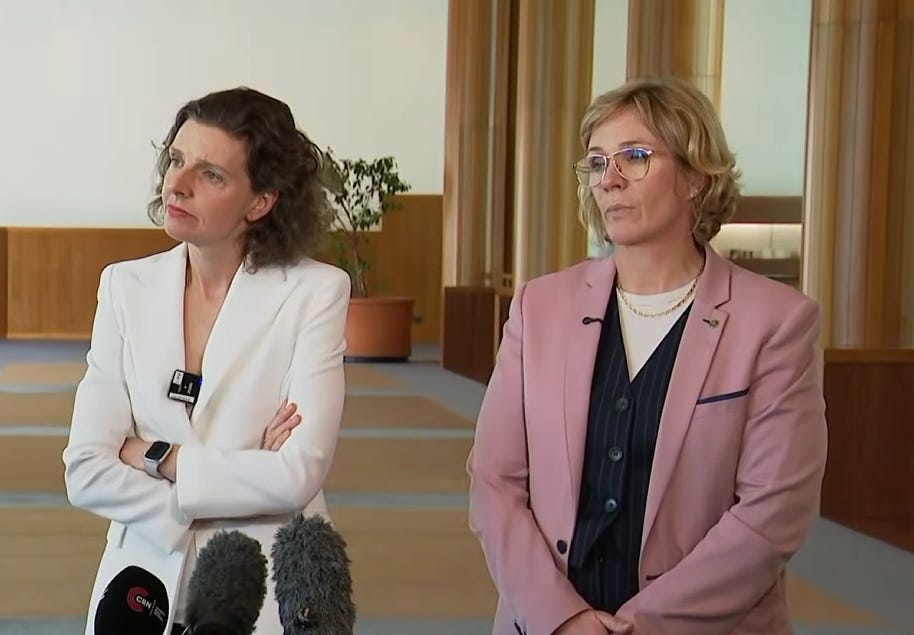
Teal independents are set to announce the formation of a new political party. This raises important questions about how the group intends to make an impact and how it will affect the burgeoning independent movements emerging from the other side of politics.
The prospective Teal party is a niche political grouping united by a few standout features: a strong position on climate, claims of being anti-corruption, conservative economic positions, and representation of wealthy electorates with traditionally conservative voting blocs.
In a majority government environment, the Teals have struggled to achieve the impact they had hoped for. Unlike Oakeshott, Wilkie and Windsor, who held the balance of power in the Gillard minority government and helped deliver one of the most dynamic parliamentary terms in modern Australian history, today’s Teals have lacked comparable influence. Caught between a Labor majority and a disintegrating Coalition, they have been trapped in the quicksand of profound political change. They now seek strength in numbers rather than strength through genuine grassroots democracy.
The affluent centrist — with progressive leanings — has become the puritanical core of the post-John Howard hellscape that is #Auspol, and the Teals have come to recognise this. After spending decades straining to be the “good guys” in Howard’s world, they have now become that world itself. While the right has moved on, exploring new ideas and challenging orthodoxies, the progressive centrist realm remains trapped deep in the neoliberal era, acting as fervent preservationists of a failing status quo. Those among them must finally recognise that they are not rebels or moral guardians but an entirely acceptable part of the managed world the powerful want us to inhabit. The right no longer seeks to preserve the Howard matrix; the conservative centrists do, and they are prepared to drag every last person on the left into their centrist vortex to maintain the illusion that they alone hold the answers.
The Teals’ success — or lack thereof — and Labor’s shallow electoral grip are not mandates from an Australian population satisfied with its political choices; they are protest votes. After decades of those protest votes being wasted on the uniparty and now on ineffective crossbenchers, they are flowing toward the most opportunistic and disingenuous political parties of all. Pauline Hanson’s One Nation is the natural by-product of that dissatisfaction and despair — the inevitable result when ideas are locked up by a disingenuous political class and the progressive elites who orbit it. The centrist party the Teals aspire to build can only be conceived from a level of comfort and insulation not shared by most Australians, and with an ignorance that many cannot afford.
The Teal party, which is mostly conservative and currently courting disenfranchised Liberal MPs and their voters, is also reshaping the public perception of what an independent is. In doing so, it disregards the organic independent movement that could spring up outside the leafy green suburbs. A confederation of Teal independents risks isolating genuine left-leaning independent movements from the outset. Teals, now more accustomed to fortifying their seats against resurgent major-party candidates than presenting bold alternatives to poor policy, will disassociate themselves from anything deemed too radical to unsettle their narrow majorities. In a short time, lofty ideals have been replaced by sandbagging Menzies-era seats (hardly inspirational). Zoe Daniel lost her seat to a reheated Tim Wilson, and the pattern is clear.
The more progressive Teals, such as Helen Haines and David Pocock, have operated more in the tradition of genuine community independents — allowing their electorates to shape their positions on national issues. They risk damaging their brand by aligning with the new Teal-led party. There is a distinct “toy village” quality to much of Teal politics: they stake out moral positions on issues they cannot meaningfully influence, while remaining timid or silent on matters where their concentrated influence in wealthy seats could actually shift policy. Some understand the difference far better than others.
True independents should enter Canberra knowing their community placed them there, not because they offer a sweeter packaging of their major-party predecessor. The election of an independent is, by its very nature, a bold statement, and their representation should reflect that. How can the Teals claim to be the frontline of independent resistance to major-party politics when not one of the seven Teals (Allegra Spender, Kate Chaney, Zoe Daniel, Monique Ryan, Sophie Scamps, Zali Steggall, Kylea Tink) supported a Labor bill to increase tax on superannuation earnings above $3 million? How can they credibly work together when some (Kylea Tink and Sophie Scamps, with Andrew Wilkie) tried to amend a motion on Israel’s actions, only for the rest to support the pro-Israel motion and defeat it?
This wave of independents has been dominated by affluent, conservative Teals rather than grassroots working-class voices from the left for a simple reason: time and money. Running as a serious independent in a safe Labor or Coalition seat demands significant personal resources and networks that most ordinary Australians lack. By formalising a party centred on these wealthy electorates, the Teals risk raising the barrier to entry even higher. What began as a challenge to the major parties is hardening into an inhibitor of broader independent politics — one shaped by class as much as by conviction. In working-class seats weary of safe-seat Labor MPs, many initially hoped the Teal model might extend leftward. That illusion has now been dispelled.
One Nation, the very phenomenon cited as justification for forming the Teal party, draws its strength from a growing disgruntled working class and claims a desire to break the status quo. With no real intention to rock the boat and nothing more to offer than neutral pragmatism, there is an element of both folly and hubris in the elite independents’ hope for incrementalism in a rapidly changing political landscape.
Rather than forming a party of select independents, a looser confederation could prove more effective — aligning on key policies while still allowing genuine representation of each community’s distinct voice. The party structure will inevitably diminish the vibrancy of independents and their true superpower: acting as a real conduit between the electorate and Canberra. These independents should be travelling the country, promoting other independents, recognising the diversity of Australian voices, and contrasting them with their own — not building gated communities in hostile territory that do little more than help their residents sleep better at night.
Potentially the most consequential outcome of the Teals’ partyfication of independent politics will be the further marginalisation of the independent left in a hostile political landscape. With the neoliberal, pencil-pushing ALP still claiming to be the party of the worker while captured by corporate unions and lawyers, the Coalition evaporating in incompetence and greed, the Greens chasing vibes and identity politics, and the Teals claiming to be the bastion of the independent movement, where else does a marginalised working-class and middle Australia turn but to the party sponsored by Gina Rinehart that claims to understand them?
The strength of independents lies in their independence — a fact that may be lost on some of the independents themselves. Zali Steggall, citing the need to counter the rise of the far right, said: “The challenge is to build something that expands our impact while preserving the independence and community-first values that define us.” Yet the essence of independence has already been compromised by the very proposition of a party. After a period of struggle, the Teals have not achieved the political impact they sought. With their energy now consumed by sandbagging Menzies-era seats rather than pursuing bold reform, the Teals have become part of the furniture. Far from challenging the status quo, they merely decorate it. The question is not whether they deserve a party, but why they bothered.
Thank you Joel for this analysis.
Regarding the current group of independents, all deserve credit for winning seats against entrenched Government Ministers in the Coalition.
As you note though, the theory of change for a Spender, Steggall or Chaney is less clear. If it is about the ‘acceptable face of capitalism’ we had that with the mythical ‘moderate’ liberal which was more about social policy than anything that challenged neoliberalism.
This sounds like the ‘Change UK’ splinter group that appeared in the final stages of the 2019 UK Parliament where the only thing uniting them was a ‘centrist’ support of the EU.
Even in terms of the current budget and Labor’s proposed tax changes, and One Nation’s polling support, it seems the appetite for the moderate liberal is not there.
If the current independants continue down the path to form a party, they have sold out their electorates and broader supporters. Party politics is not democracy. Only independants elected by their community truly represent their electorate. I have been supporting the ‘Voices of’ movement since Cathy McGowan 1st took Indi. No electorate I have voted in has yet become independant. My hope was , by supporting the concept , change would eventually come. This is disappointing. Democracy is doomed., Billy