
From 'Dancing with the Stars' to preferred opposition
Pauline Hanson’s improbable Journey from pariah to power and how bipartisan failure, big money and unaddressed working-class rage resurrected One Nation.


The rise of One Nation to the preferred party of opposition is a story that requires attention, as polling recently demonstrates a major swing towards the far-right party, reflecting an electoral shift that is poorly understood by those in the major party brains trusts and irresponsibly toyed with by the concentrated right wing media.
Recent polls paint a dramatic picture: Roy Morgan’s post-budget SMS poll (May 13-14 2026) showed One Nation on 32% primary vote; ahead of Labor on 28.5% and the Coalition on just 16.5%. Newspoll gave them around 27%, Resolve 24%, and Freshwater 26%. One Nation even won the Farrer by-election in May 2026 with a commanding primary vote. This is no longer a fringe protest, it is a vote that has grown rapidly, and it is a genuine challenge to the two-party system.
While the Australian political spectrum embraces or recoils at the prospect of Pauline Hanson’s One Nation Party receiving a potential power-share in Australian politics, those who celebrate One Nation’s ascendancy do so through pure political disenfranchisement, while the detractors critique the rise of the far right through a misguided condescension: both missing some of the causes behind the symptoms manifesting in different ways on both sides of politics.
Sliding door moments. It was 2004, Pauline Hanson had just gotten out of jail, and was a pariah. She was in between fish and chip shops, and cast asunder from the political mainstream; including the concentrated press that used her up and threw her away like a washed up Hollywood star. After being repudiated by the majority of the country, Hanson’s return was cast on the backdrop of a country going to sleep.
In the background a neoliberal hum was ringing in John Howard’s Canberra. Australia was beginning a period of deep ideological stagnation under the helm of a new breed of politician.
This isn’t a story of mockery, or ridicule that frames some of the analysis of Pauline Hanson and One Nation. This is a piece about the power of persistance, and how perseverance, and a lot of money from Gina Rinehart, and the absence of a coherent left can go a long way in a deliberately politically stagnant Australia.
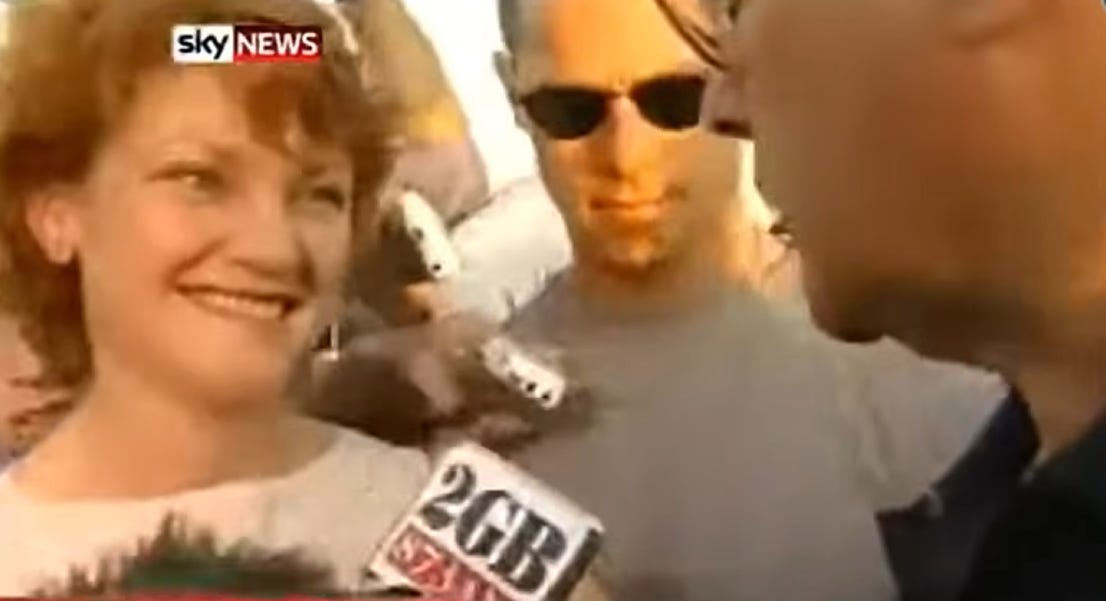
Hanson spent ten years in the political wilderness after her appearance on Dancing With the Stars in 2004, doing media and running unsuccessful independent campaigns, before reclaiming the leadership of One Nation like a redheaded Rocky from Ipswich. In this time John Howard ceded to Rudd/Gillard and back to Abbott, and a neoliberal autopilot carried on — one part mining boom, one part global war on terror, and equal parts not good enough. The training montage of Hanson’s Hail-Mary return into politics occurred during a decade of Coalition revisionism and Labor playing small target politics, and the rise of populism in the West.
The internet had nebulised the voting bloc, and the politics had eroded public sentiment. Post-pandemic Australia became a different political landscape, ending the Coalition’s reign and giving Labor another chance to do not much else different. The neoliberal autopilot had become a conveyor belt, and Labor demonstrated that it would do nothing more than offer much of the same policy imperatives as its predecessor: tax cuts, AUKUS, oil and gas licences to foreign tax-dodging giants.
Labor’s first term, laden with the disappointment of small target government, was followed by its second term of economic, diplomatic and military support for policies that many voters saw as disconnected from domestic suffering (like Israel’s genocide in Gaza), while rents soared, wages stagnated, and essential services creaked. The working class watched on as their concerns were sidelined.
On the left, the abandonment of working class politics over identity politics has disconnected it from a swathe of people in Australia who may hold working class values but now ascribe them to One Nation. That’s more than a strange anomaly, it’s the mistake of the major party left and the ideologies of the further left that created a vacuum. Economic anxiety, cultural displacement, and the sense that no one in Canberra was listening became fuel. Many on the left doubled down on abstract theory while the battlers looked for someone who spoke their language — even if imperfectly. Some of the blame in the political shift lays with the left alternatives and minor parties that have failed to connect with marginalised working class communities with tangible soultions.
This isn’t about some concessions to load into the right, it’s the opposite. It’s about identifying the struggles of Australians through the lens of Marxist economic fundamentalism, and reaching out to disenfranchised Australians with better ideas.
Hanson and her party are totally neoliberal, partnered with Gina Rinehart, and less about the poor and struggling than they might want to admit. Unashamedly Trumpist, a fan of the US imperial status quo, and a friend of the media, One Nation is no more than a protest vessel riddled with contradictions. They rail against globalism and foreign ownership while accepting major support from mining interests. Gina Rinehart’s associates have gifted One Nation a private plane worth over $1.5 million, along with millions in donations from executives like Ian Plimer and Adam Giles. Hanson has taken multiple undeclared or taxpayer-claimed flights on Rinehart-linked jets, yet the party pushes economic nationalism, protectionism, tariffs, and “Aussies first” welfare: quite the contrast when it comes to One Nation’s claim to be the party of the battler.
The John Howard guide to government, passed down successfully through every bipartisan iteration of government to this day, has revelled in an atrophied cultural malaise on three decades of a badly managed mining boom. And apart from Argentina, a few remaining ingrained African post-colonial nations, and the planet Arrakis, there isn’t much to compare this country to. The Coalition talk about making Toranas, and the ALP delivered a budget dismissing no social welfare to poor children, while house prices remained a generational insult. The major parties have had decades to provide the conditions to avoid One Nation, and Labor — coiled in a box claiming it could be an alternative — has only come to government to drive the same John Howard era neoliberal jalopy with a Medicare bumper sticker.
Seeing the sliding doors moment now and the ‘Return of the Pauline’, the point where voter patience snapped, should terrify the establishment. One Nation’s return is not the disease. It is the fever. The real illness is three decades of managed decline dressed up as responsible government: a badly managed mining boom that left dust and empty towns, a political class more interested in international virtue than domestic wages, and a media environment that mocks the symptoms while protecting the causes.
The question isn’t whether Hanson deserves power. The real question is why so many Australians now believe the major parties have left them no better choice. Hanson offers no genuine escape. She delivers only a loud, Rinehart-funded echo chamber wrapped in nationalist clothing. Her party rails against the elites while cosying up to mining billionaires. It speaks for battlers while protecting the resource aristocracy, and it trades Canberra’s neoliberal autopilot for Washington’s imperial one. Its a shame that there isn’t a visible alternative.
Until that vacuum is filled with real economic sovereignty, serious material relief for the working class, and a politics that puts Australian citizens first, not donors, not ideology, not foreign powers or mining magnates, the doors will keep sliding toward more disruption, not less. Pauline Hanson may be the fever, but without a proper cure from the left, Australia risks mistaking the symptom for the medicine.
Sad but oh so true. If only the ALP had some courage - it could have been so different
Fuck you do a hell of a good article Joel.
This one’s a doozy.
If I could, I’d have it injected into the veins of every Australian citizen. And then I’d make them do a comprehension test & I’d keep behind till they passed it.