
Canberra silent-running towards Armageddon
As the skies darken over Tehran and the oil flows dry up across the Gulf, the echoes of a choice will haunt Canberra long after the last missile falls.

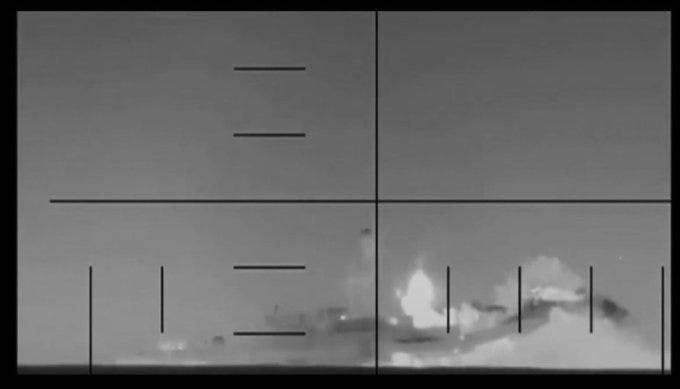
The Prime Minister Anthony Albanese smirked when he confirmed the involvement of Australian submariners onboard a US submarine that torpedoed an Iranian warship (IRIS Dena) returning from neutral military exercises in India. “I can confirm that there were three Australian personnel onboard that vessel,” said the almost cheerful PM in an interview with Sky News Australia, alluding to the fact that Australian service personnel have been involved in the opening salvo of a war that is threatening to upend the global economy and millions of lives in West Asia.
Australia’s Initial Involvement in the Conflict
The submarine attack was the gravest naval attack since the Second World War—ignoring conventions and the laws of the sea—striking the Iranian warship in international waters—an event Iran’s Foreign Minister Abbas Araghchi has called an “atrocity at sea”.
The Sri Lankan navy rescued 32 sailors while recovering 87 bodies, and a fairly unanimous response of support followed throughout the mainstream political class. This included the opposition leader, cabinet members in both major parties, and the increasingly tight spectrum of mainstream political orthodoxy that appears to revolve around a central consensus. Even the Greens—who have provided an outlet for anti-war voters during the UN-declared genocide in Gaza—spoke about the oppressive regime in Iran right up until the day of the invasion, before condemning the illegal attack by the Israel-US coalition.
Only days earlier as the news came in of 175 dead schoolgirls killed in an AI-powered Israel-US attack on the Minab School in Tehran, Australian Prime Minister Anthony Albanese gave one of the most vociferous responses is in the OECD By praising the US-Israeli invasion into Iran by saying “We support the United States acting to prevent Iran from obtaining a nuclear weapon and to prevent Iran continuing to threaten international peace and security.”
The Prime Minister placed Australian government support for the war on full display while hosting Canadian Prime Minister Mark Carney. Both leaders offered different versions of the same position—and it was fascinating to watch two empire lapdogs perform on opposing sides of the short tether afforded to them by Washington. On one side, Carney initially expressed support for the US-Israeli strikes on Iran but later qualified it “with some regret”. Albanese, meanwhile, insisted on eliminating Iran’s “ongoing threat” to peace and security, choosing to go all the way with Donald J. Trump.
This gung-ho position was challenged by Insiders host David Speers in an interview with Foreign Minister Penny Wong. She parried questions about Australian involvement in the quagmire, stating, “We’re not in a position to determine the legal basis of decisions the US and Israel have made.” While Wong and her party attempt to unravel their own hubris to justify a war that began with a salvo assassinating a religious leader and killing nearly 200 schoolgirls, Australia has already made its mark. Eighty-seven dead Iranian souls, and the hollow words of this government, stand as a lackadaisical and ignorant testament to the gravity of the event.
“Turn the temperature down,” Albanese had urged a divided nation, before plugging Australia into a Netanyahu-Trump war in the wake of Epstein. Only days earlier he had promised not to send Australian defence personnel to the region, only to backflip almost immediately and consider requests for military assistance from Gulf states. Sensing Australia’s automatic involvement in another US war in-and-around the delineations of Greater Israel, Israeli Foreign Minister Sharren Haskel tried to weigh in on the level of that involvement: “Wake up and fight for Israel and ‘freedom’,” said a member of a government that is committing genocide and engaged in active combat across several countries in the region.
So while the government backflips after insisting Australia would not take part in any military operations inside Iran—despite our service personnel being involved in a Lusitania-type incident from the outset—it cannot completely rule out the use of US bases in the country. As the conflict evolves, with French and European military assets being deployed to the region, Australia’s position could change dramatically—especially if Washington decides to drag its allies by the scruff of the neck into a “coalition of the willing”. In Washington, Donald Trump brushed away the fact that more American lives will be lost in this war for Israel: “There will likely be more. That’s the way it is,” he commiserated, amid murmurings of troop deployments and a protracted regional crisis.
Political Support and Policy Shifts
Australia has deployed military assets to the Middle East as the conflict with Iran spirals out of control. Prime Minister Anthony Albanese announced that a Royal Australian Air Force C-17A Globemaster heavy transport aircraft and a KC-30A Multi-Role Tanker Transport would be part of the second of four confirmed flight to the United Arab Emirates (UAE) aiming to evacuate some of the 115,000 Australians trapped in the region. But what could further involvement look like?
Amid scenes of total solidarity from the Iranian population rallying behind their besieged government, the White House has pivoted its objectives rapidly—from liberating the good people of Iran, to vowing to stop its missile capability, to demanding unconditional surrender. In reply, Albanese has shifted from “no troops”, to evacuation flights, to considering requests for military assistance from Gulf states. Going by the last few days, the shy is the limit.
Trump spoke in genocidal terms on a flight before the media about the people of Iran, blabbering about the possibility of no Iranians being alive when they are done, calling them “among the most evil people ever on earth”. “The only ones that need to be worried right now are Iranians that think they’re going to live,” said Secretary of Defence Pete Hegseth with the zeal of a zealot. Why is Albanese scratching at the feet of people speaking the most unhinged language of war from any government since Menzies committed Australian troops to Vietnam?
Historical Lessons and Future Risks
Unlike Vietnam, which defeated the United States after a decade-long battle of attrition, Iran is a continuous civilisation state. Its population dwarfs that of 1965 Vietnam; Iran is six times the size of Vietnam; its military is a modern, self-reliant regional deterrent compared to the guerrilla armies of the North Vietnamese Army. Iran has near-universal youth literacy, the highest proportion of female STEM graduates in the world, and is an institutionally deep nation with native AI, satellites, and tech-enabled regional-superpower status.
The US took 20 years, hundreds of lives, and trillions of dollars to replace the rudimentary-equipped Taliban with the Taliban—currently it cannot stop the Houthis in Yemen. How are they going to topple a 90-million-strong superpower? Even a bloody war of attrition leading to US troops on the ground in Tehran would result in a modern, heavily armed, and well-trained Taliban-like situation, with decentralised military units fighting across the region for decades.
The US has suffered one of its biggest military losses since Pearl Harbour. The most valuable US bases on earth—in Bahrain and Qatar—trillions of dollars of assets built over decades, including billions in extremely finite and valuable early-detection radars throughout the region, have been hit. Iranian missiles are finding their targets with increasing success, drones are flying unimpeded into highly sensitive sites, and the damage across US-Israel positions is devastating.
As the Iranian response defies even the most optimistic assessments in Washington, Trump is drawn deeper into the conflict and faced with an increasingly grim set of options: retreat and lose the Middle East, put boots on the ground and risk American lives, or deploy a nuclear response and doom the fate of humanity. With these bleak choices beginning to harden as the conflict complicates and compounds, why are Albanese and Wong so keen to show their zeal for the Trump-Netanyahu war—more so than any government in the West?
This overreach did not emerge in a vacuum; Australia has demonised Iran for a long time, evolving as it became screwed into the “Axis of evil” during the US global war on terror. It has only ramped up what had been fairly stable relations after ASIO claims that Iran was involved in a string of antisemitic attacks in Australia, leading to the suspension of diplomatic ties with Tehran. The image of the Ayatollah’s imposing figure to an ignorant and propagandised public, alongside decades of reports about human rights abuses—particularly against its female population—has sat alongside the unrelenting efforts of global Zionist interests to dismantle the regime in Tehran.
All the talk about the brutality of the Iranian state and the demonisation of billions of Muslims has morphed over thousands of kilometres through the propaganda of empire and media, casting a heartless detachment from conflict abroad in Australia. This detachment can even be seen in pro-Palestinian supporters trying to square the circle on justifying the assassination of Ayatollah Khamenei, while condemning the lunacy of the Netanyahu-Trump-Epstein invasion. Many who see this conflict struggle with cognitive dissonance, trapped in the shallow national discourse of Australia. After the Western-backed destruction of Iraq, Afghanistan, Syria, and Libya, and CIA-backed coups in Egypt, Iran is the last state to evade subjugation to US-Israeli domination in the Middle East. Bipartisan governments in Australia have supported each of these conflicts with words and military contributions, and this government would always join in the misadventure now unravelling.
Have we not learned the mistakes of Iraq and Afghanistan? Or Vietnam and Korea? Since Richard Perle put together the “Clean Break” memo that architected the wars of the Middle East for Israel, and since Netanyahu has spend his adult life banging the drum for nearly four decades about Iran being on the verge of acquiring a nuclear weapon—with invasions of Iran depicted in video games and movies—all roads have led to a President weak enough to acquiesce to Israel’s plans for regional hegemony. They found their man in Donald Trump. Why do so many in the West blindly support this fate?
The Cost of Involvement
In order for Australia to see its sovereign future, it has to shake off the tunnel vision that has seen it nestle into US-led wars of aggression. The simplicity of Australian decision-makers, the shallow thinking, the ignorance, and the lack of creativity have become endemic in the class of politicians that hold sway in Canberra. Trapped in the spoon-fed mindset of an imperial prism— constructed by John Howard—a crystallised nexus of thought reflects bad ideas off mirrors held up by our political class, refracted through foreign-owned media, and beamed into our policy.
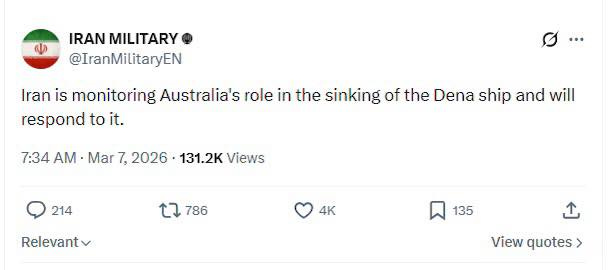
To apply any credit to the leaders of this country would be a stretch, but the situation they face would not be pleasant. The increasingly narrow lines of core vassal status yield increasingly less sovereign mobility, compounded by decades of bipartisan acquiescence and outsourcing to Washington, and capped off by AUKUS. Just like Trump’s dangerous overcommitment to unconditional surrender in Iran, the Albanese government’s decision to double down into the Israel-US war also doubles our visibility. Tehran has noted Australia’s involvement in the submarine attack on its destroyer and is considering retaliation options.
Toxic rain is falling over the capital city of Iran, and Tel Aviv, Haifa, and Beit Shemesh lay in ruin, making for apocalyptic scenes. Tit-for-tat strikes on desalination plants, oil refineries, and military installations see untold devastation in the region. The Gulf states may never recover. Apart from bronze-age statements calling for the utter subjugation of the Persian landmass, the endgame is not clear. If there ever was a time for leadership in Australia, it would be now.
Back at home, after the women and children of Iran inhaled toxic fumes from strikes on oil storage tanks, Albanese was celebrating his female party members for International Women’s Day, fluffing around about his government’s cost-of-living measures, at a country that is seething. A few days into this war that Australia has fired shots in, small businesses break at the petrol pump, single parents on the edge see the prices of essentials jump, and the consequences of being at the bottom of a just-in-time global supply chain—in a hollowed-out neoliberal service/mining economy a few reviews away from Argentina status—start to roost.
Support for this brutal invasion is a coffin nail in this country, and Albanese’s decision to support the war in Iran may not impact the fuel prices in the scheme of things, but it has trampled on the last vestiges of Australian moral and strategic independence only to join the closest thing to World War 3 we have yet to see in this world. As the skies darken over Tehran and the oil flows dry up across the Gulf, the echoes of that choice will haunt Canberra long after the last missile falls—marking not just the end of an era, but the quiet surrender of a nation’s soul to a fire it helped ignite.
Thank you for this important post . The manner in which Albanese has enthusiastically leapt to the support of America and Israel re this illegal attack upon Iran is breathtaking . One can only wonder what might be the threats against him ( or his family ) if he fails to kowtow to their war mongering and obscene inhumanity .
The rhetoric of Hegseth , as he wallowed in his perceived glory of doing to Iran what has been done to Gaza , speaks to his
blatant unfitness for any position of influence , let alone comparing this war against Iran to the Christian Crusades.
How Albanese can allow this country to be swallowed up by such a war mongering regime is unforgivable , and a massive betrayal of our people .
The morally bankrupt scum that sit in Canberra are at least contributing one important thing to promote a better Australia - the death of the major parties. These reprobates all have their noses in the same trough - providing undeniable truth that there is absolutely no difference between the ALP and the Liberals.