
A nation in shock deserves unity, not opportunistic division
At a time of raw national mourning, Australians deserve better than opportunism—we deserve leaders and voices that unite rather than divide.

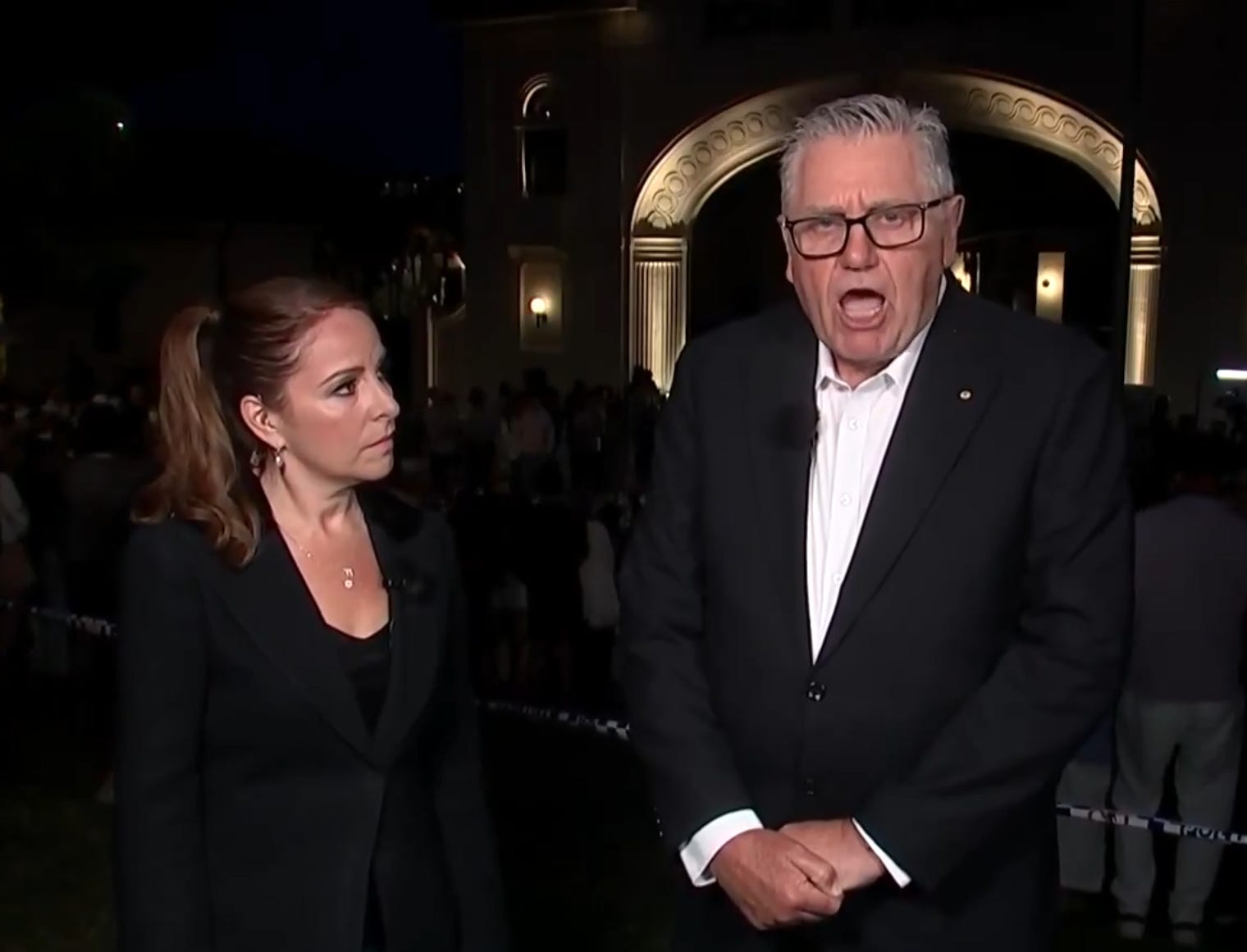
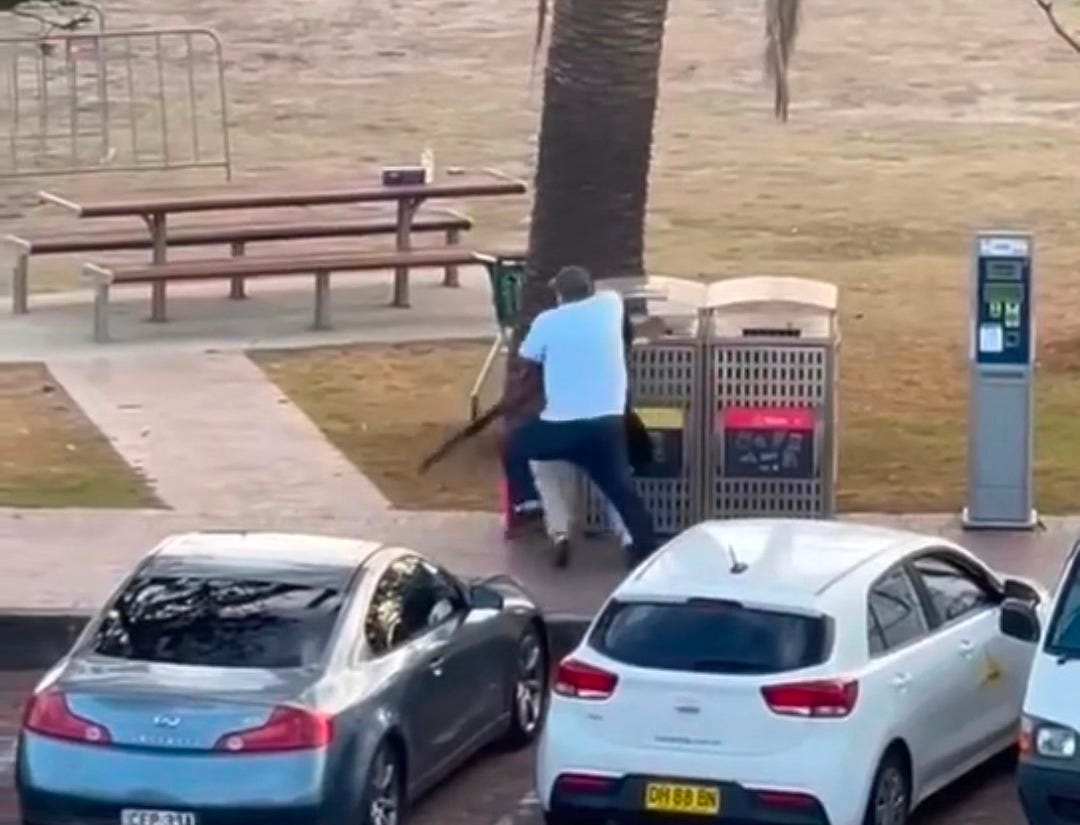
The terrorist shooting attacks at Bondi Beach, which targeted Sydney’s Jewish community during a Hanukkah celebration, have shocked Australians. They cannot be excused as anything other than a heinous act of violence that undermines the values of our peace-loving, secular nation.
As the death toll from the attack on the Hanukkah gathering rose, Australians grappled with the country’s worst mass shooting since the 1996 Port Arthur massacre—a terrorist act that killed 15 people and wounded dozens from Sydney’s Jewish community. In shock, the nation sought solidarity from bipartisan leaders, public officials, and media—a reasonable expectation during such tragedy.
One key point is that this was an attack attributed to a father-son duo reportedly radicalised and inspired by Islamic State ideology. Important questions remain about ASIO’s prior monitoring (one shooter was previously a subject of interest), their alleged training in the Philippines, current gun laws that allowed access to the weapons used, and how such an attack occurred on Australian soil. These issues deserved more media scrutiny.
Before the details surrounding the shooting were clear, among the environment that saw bubbling anger mixed with overwhelming grief, opportunists appeared and sought to stoke the former rather than enable the latter. The press were on the ground within hours of the tragedy, suggesting questions about the viability of the Albanese leadership to victims and concerned attendees, rather than asking about their wellbeing, their condolences, or even if their families were OK.
Initially, Indian and American media falsely reported the nationality of one of the shooters (Naveed Akram) as a Pakistani national, where the butterfly effect of his alleged Pakistani identity went all the way around the world before the truth of his Indian-Italian identity even got it’s boots on. After footage emerged of Muslim Syrian-Australian hero Ahmed Al Ahmed disarming one of the attackers in a selfless act, Israels Prime Minister Benjamin Netanyahu; claimed that Al Ahmed was in fact Jewish, and when that information was dismissed as false, other misinformers, moved on to claim the hero was Lebanese Christian. A claim dispelled by Al Ahmeds own Syrian muslim father, who praised his son as a ‘hero of Australia’.
The most subjective of punditry from those like Latika Bourke and Phil Coorey took turns repudiating the Prime Minister for failing to meet the moment, criticising the government for enabling the attacks through its policy, and ultimately lambasting the Australian public for overwhelmingly opposing Israels genocide, accusing Albanese of allowing an environment that made the country grow “used to it (antisemitism)”. Ray Hadley exemplified the irresponsible essence of the Australian legacy media angle around framing the case, and showcased its ultimate incompatibility with the average Australian, when he angrily called for the PM to resign, yelling “coward” and “disgrace”, and accusing the PM of supporting Hamas; “they’re (the government) are as responsible for this as anyone”.
By Tuesday, the opportunists of the political class caught up with their media counterparts, and were well front and centre with narratives that seemed to be running counter-intuitive to the messages of calm, reflection and cohesion from government, police and intelligence--falling well afoul of the expectations of Australian who were shocked by the shooting and expecting a grown up response. Pauline Hanson and her freshly minted sidekick, Barnaby Joyce, walked around a vigil shadowed by right-wing commentator Avi Yemini, the ABC interviewed former-PM Scott Morrison for his divisive take, and the calls for the resignation of the PM were echoed by his political opponents lurking around the tragedy.
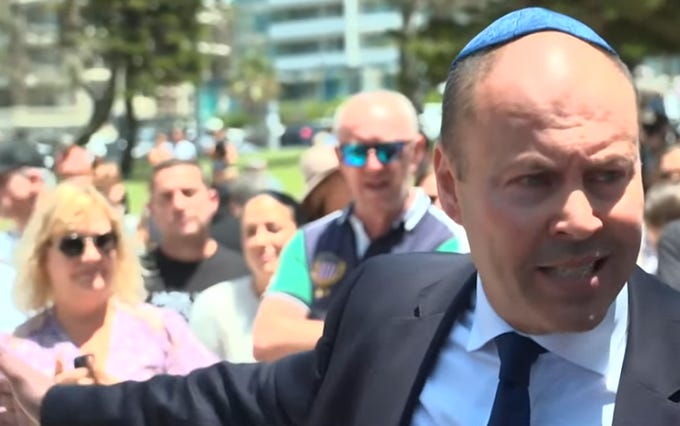
By Wednesday, the opportunism had reached its peak after Josh Frydenberg, fresh after his own fiery repudiation of Albanese, announced his political comeback at the site of the tragedy. The speech was divisive, inappropriate for such an occasion, and when asked by Sarah Ferguson on ABC 730 about the public perception of his political motives, the former Treasurer Josh Frydenberg snapped back without answering, “I am deeply offended”.
The politicisation of national disasters has been there for some time. One side looks to corner the other using political wedges; Labor criticised Morrison in Hawaii for claiming not to hold hoses, the coalition blasted Albanese for his response to NSW floods—and the media has joined in to politically repackage every disaster into a political object that can be used to inflict blunt force. Seemingly gone are the bipartisan calls for calm and pragmatism that we saw during Port Arthur; instead we see John Howard, Prime Minister responsible for the response to Australia’s worst-ever shooting event, taking a steaming dump onto Anthony Albanese, the Prime Minister today who oversees the response to the worst act of political violence in Australian history.
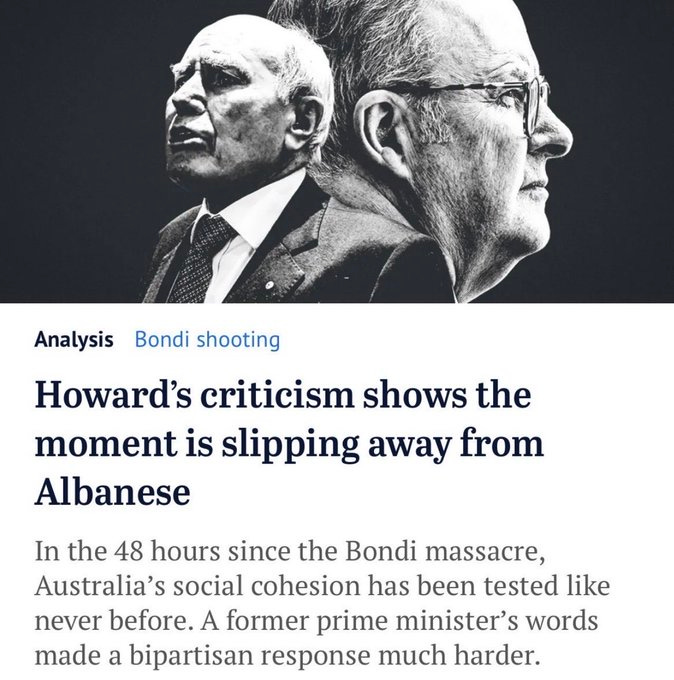
Suggestions that demanding Palestinian statehood and an end to Israel’s ethnic cleansing in Gaza and the West Bank puts the blood of Bondi’s victims on the hands of Palestine’s supporters are just idiotic and risible. As is the “it happened on Albanese’s watch so he must go” claim, which, to be consistent, would have resulted in John Howard’s resignation after Port Arthur. – Dr. Scott Burchill
As this nation mourns, the opportunists who have ridden our backs during pandemic, bushfires, floods, and genocide are looking to split national catastrophes into political modules that can be shifted to suit their ideologically motivated narratives, compounding another tragedy before the blood is even congealed. Do they know no limits? The opportunists are suggesting that more public restrictions on freedom of expression be employed rather than addressing the firearms, vetting processes, and intelligence failures that led to the actual psychopathic attack, blaming Australians for the tragedy and expecting them to pay the bill with their own democratic freedoms.
And the very media and politicians who are interested in preserving this country’s national interest are acting as conduits of misinformation into a global network of sophisticated propaganda that has been weaving around narratives shaped out of Tel Aviv. The Israeli government acts as an unwelcome presence in this tragic domestic affair, with former Australian PM Malcolm Turnbull who warned Benjamin Netanyahu to “stay out of our politics,” after the Israeli Prime Minister said Australia’s support of a Palestinian state was the direct cause inflaming anti-Semitism in the country.

In Israel, people who lost their family members on October 7 and in Gaza challenged the Israeli narrative being piped down on Canberra and wielded in the Australian press, noting that their Prime Minister blames the Australian government for the Bondi tragedy that killed 15, but takes no responsibility for its own failures that saw over 1000 killed on the events of October 7. ABC Global Affairs Editor Laura Tingle echoed this observation, remarking that the comments coming out of Israel “have to be taken with a grain of salt.” Israel has looked to add its own two-cents into this tragedy, but as it squares the circle to tie the Sunni extremist attack to Shiite Iran, it tramples on the dead victims it is claiming to support.
It was disgraceful to see the Prime Minister of Israel call out the failures of the Albanese government to protect Australian Jews when his leadership saw the breach in security that led to the events of October 7, and the very man that mocks his government for not being able to keep people safe has subsequently sent his armed forces into an area where they have ethnically cleansed the Palestinian population in a UN-declared genocide, where they have engaged in the worst war crimes in this century.
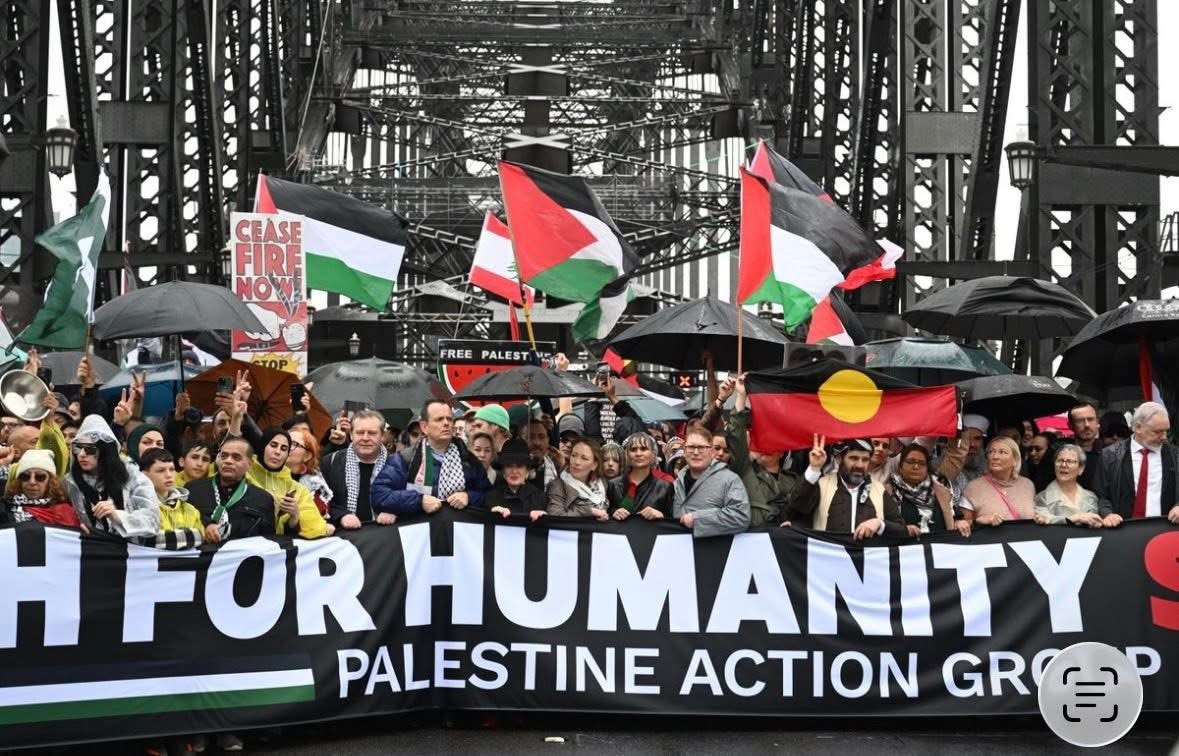
The 300,000 people marched across the Sydney Harbour Bridge, including sitting government ministers from both sides of politics, combined with the 58% of Australians that agree there is a genocide, and the 69% that want Israel to end its campaign in Gaza. The banshee screaming coming out of a small section of the Zionist political and a captured media apparatus may seem loud and scary to Albanese, but he has to balance that with an overwhelming public sentiment that has had a gutful of Netanyahu, Trump, and all the bullshit that’s been pushed upon our country over the last two-and-a-half years since the genocide became a status quo and the world we used to know turned on its head.
The Prime Minister hasn’t had an easy relationship with the Australian Jewish community over his time in charge in a post-October 7 landscape that is barely recognisable in this secular island continent with boundless plains to share. In the times since genocide has become a daily occurrence, for over two years the disproportionate response of Netanyahu’s Israel to the events of October 7 has been met with a similar amount of pressure from the Zionist end of Australia’s Jewish community to change the Australian social contract to limit criticism of the very thing that is causing all the social unrest.
It must be remembered that the biggest threat to the safety of Jews in Australia—and the spread of antisemitism—is not Australians; it’s not immigrants; it’s not guns. It is Benjamin Netanyahu and his extreme government, which have been committing a UN-declared genocide in Gaza for over two years. And during that genocide, the state of Israel has commandeered the global Jewish population as participants and supporters of its actions in Gaza, has sought to commandeer Jewish communities around the globe, and has aimed to influence the politics of nations with populations that oppose its actions in the Middle East and the role their own governments play in supporting Israel. Rather than addressing the continued death and displacement of Palestinians in their occupied lands, Israel seeks to restrict opposition, avoid litigation, and ignore international law. And rather than call for peace, it asks a grieving community of Australian Jews to push for more war.
Those in media and politics chasing short-term advantage should pause and consider: a grieving nation is not easily misled. Many believe the ongoing conflict in Gaza, and the insistence on its continuation, fuels antisemitism far more than domestic speech or isolated extremists ever could. No firearm, no lone maniac duo, and no law conflating legitimate criticism of Israel with hatred of Jews will alter that deeper reality.
In the end, far too much facile commentary has been spilled on the Bondi Beach massacre for narrow political gain, and far too little serious reflection offered. At a time of raw national mourning, we deserve better than opportunism—we deserve leaders and voices that unite rather than divide, that focus on real security failures rather than imported battles, and that allow the country to grieve before rushing to score points. That, above all, is what the victims and their families have earned.
Thank you for your analysis Joel.
Some of the most craven individuals have emerged to make capital off of this heinous crime.
The investigation has not even concluded and now sweeping changes are proposed to clamp down on our few remaining civil liberties. No one can blame the PM for this crime, but he can be blamed for the legislative response. Their proposal? A Censor with Executive, Legislative and Judicial powers to ‘correct’ the public narrative against criteria they will control.
Josh Burns, Julian Leeser and the insufferable Frydenberg (who as we remember lost his blue ribbon seat to a first time candidate) demand the adoption of a report written by Segal which went through no Parliamentary review. Have they even read it? This is an outrageous attempt to seize control of our civil society in education, media and politics.
Joel, this is a great response. The call for unity over opportunism feels right, especially while the ground is still moving under people’s feet. What struck me most is how quickly grief gets rerouted into culture war, because it’s easier than doing the unglamorous work that actually prevents the next attack.
If we’re serious, the focus has to stay boring and structural: firearms access, intelligence failures, follow-through, media discipline. Policing protest or blaming public opposition to Israel’s actions in Gaza for a domestic terror attack isn’t accountability, it’s displacement, and it avoids the hard questions about guns, intelligence failures and media irresponsibility.
I also think you’re right to flag the danger of imported narratives. Letting overseas leaders or their local amplifiers frame Australian grief for their own ends corrodes trust here. Jewish safety in Australia is non-negotiable. So is the right to oppose mass civilian killing without being treated as suspect. The only reason those get pitted against each other is political convenience.
Holding that line, calmly and without theatrics, is the adult response this moment calls for.